A clean route from network to computer
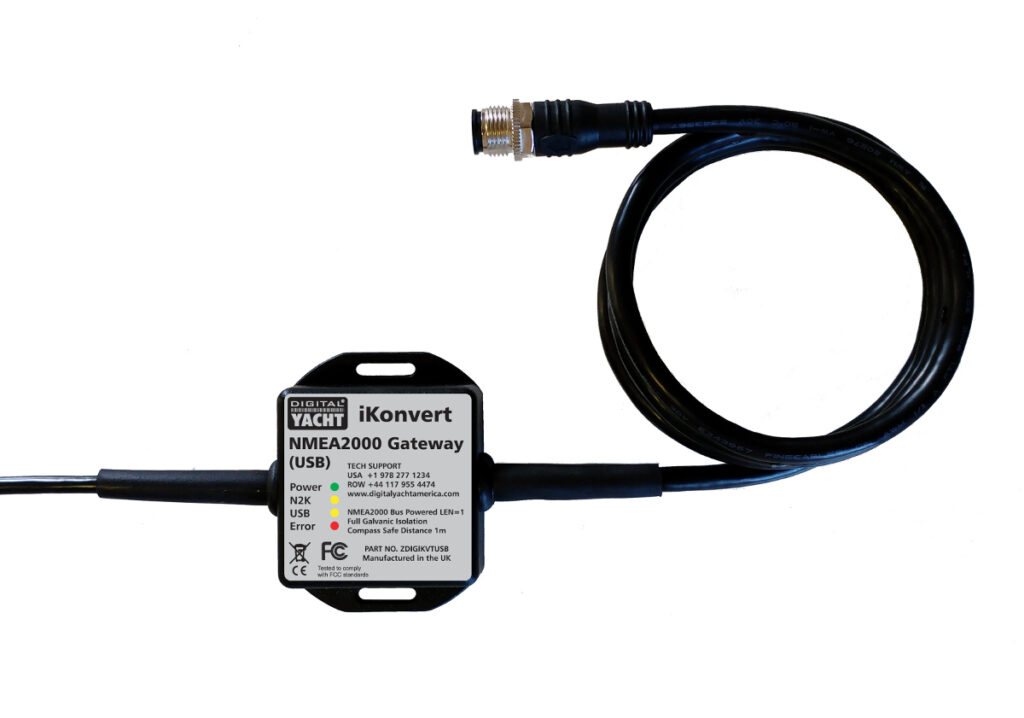
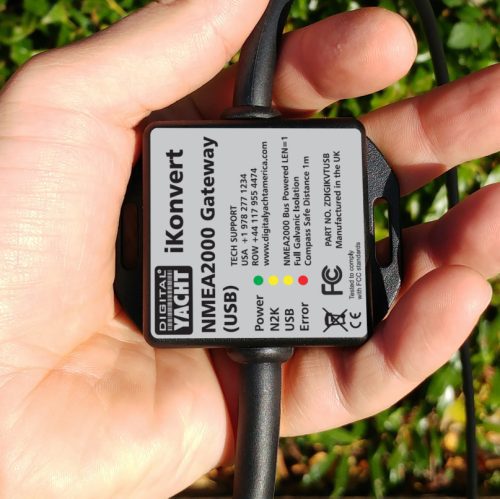
When a laptop is meant to log or diagnose a National Marine Electronics Association (NMEA) 2000 network, the data must cross cleanly and the operator must know which format the software will receive. Digital Yacht’s iKonvert turns NMEA 2000 into a universal serial bus (USB) connection for £216, with cabling, power, operating modes and galvanic isolation resolved in one compact gateway.
I see the practical consequence immediately. The iKonvert takes power from the NMEA 2000 backbone, carries an integral Micro male drop cable and presents an integral USB Type-A lead to the computer. For a navigation computer, survey laptop, service bench or high-hour monitoring installation, fewer junctions mean a clearer fault-finding path.
Two useful ways to handle the data
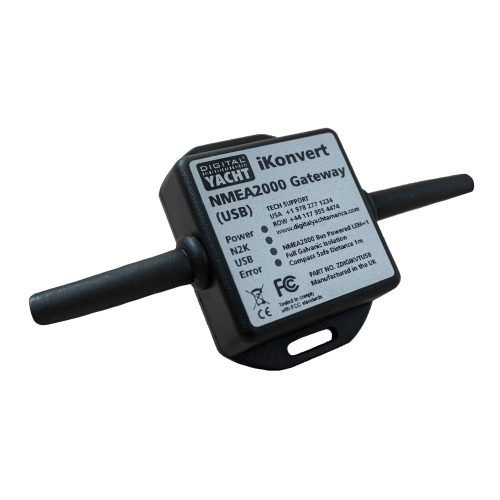
The first route is conversion to NMEA 0183 text data. That format remains widely accepted by navigation applications, so iKonvert can extract key position, speed, heading, wind, depth and Automatic Identification System information from the modern network and deliver it at 4,800, 38,400 or 115,200 baud. I can match the output to the program without asking the program to decode the native network traffic. For a skipper who wants charts, logging or familiar instrument sentences on a computer, that is the direct and understandable mode.
The second route is raw binary parameter group number (PGN) data at 230,400 baud. That supports analysis, development and two-way control for software able to interpret NMEA 2000 messages. Digital Yacht publishes the serial format, and the product is compatible with CanBoat and the Signal K Node Server. I value that openness because the same interface can serve ordinary navigation software and a deeper diagnostic task later.
The transfer is bi-directional. An application can read from the network and, where its design and the vessel’s controls permit, write data back. I would approach any transmitting function deliberately and verify the chosen mode. Read access is useful for logging; write access carries responsibility.
Setup without another software layer
Internal dual in-line package (DIP) switches select the data mode. No separate configuration program or firmware change is required for that basic choice. I like this on a working installation because I can document the switch position, close the case and know how the gateway is set. The Future Technology Devices International (FTDI) USB 2.0 interface has established driver support across Windows, macOS, Linux and Android. That broad platform list is one of the iKonvert’s strongest points, particularly when a service engineer may arrive with a different computer from the one permanently aboard.
Full galvanic isolation separates the USB side from the NMEA 2000 network. In plain language, it prevents a direct electrical path between the computer and the marine data bus. I regard that as essential engineering in an interface that joins two powered systems, especially when a laptop charger or shore supply can introduce an unwanted ground route. Isolation is not glamorous on a product page, but it is precisely the kind of feature that earns confidence over years of connection and disconnection.
I would secure the housing, support both leads, keep the Micro connector within the permitted drop length and place the USB plug where it can be reached without hanging from the computer. The compact enclosure suits a helm void or electronics panel, while the lack of another power pair reduces clutter.
Digital Yacht iKonvert vs Yacht Devices YDNU-02 vs Actisense NGX-1-USB vs ShipModul MiniPlex-3USB-N2K
| Model | Current UK price | Difference vs iKonvert | Computer connection | Data handling | Platform support | Setup method | Marine-network connection | Isolation and practical role |
|---|---|---|---|---|---|---|---|---|
| Digital Yacht iKonvert USB | £216 | — | Integral USB 2.0 Type-A cable with FTDI interface | NMEA 0183 conversion plus published raw binary PGN mode; bi-directional | Windows, macOS, Linux and Android | Internal DIP switches; no special configuration software or firmware change | Integral NMEA 2000 Micro male drop cable; network powered | Full galvanic isolation; direct computer access, logging, development and app control |
| Yacht Devices YDNU-02 | £210 | £6 less | USB 1.1-or-later virtual serial port; male or female USB options | NMEA 0183, native NMEA 2000 binary, readable raw and automatic modes; bi-directional | Windows, macOS and Linux | Command-line or terminal service menu; diagnostic recording and filters | NMEA 2000 or SeaTalkNG connector options | High-voltage galvanic isolation; computer gateway and diagnostics |
| Actisense NGX-1-USB | £219 | £3 more | Moulded USB Type-A cable; USB 1.1, 2.0 and 3.0 compatible | Pure NMEA 2000 transfer and NMEA 0183 conversion; up to 230,400 baud | Computer applications; Actisense Toolkit and NMEA Reader | Software-configurable transmit/receive lists and rates | Integrated 1.5 m NMEA 2000 drop cable; network powered | 1,000 V tested galvanic isolation; rule-enforcing firewall and diagnostics |
| ShipModul MiniPlex-3USB-N2K | £379 | £163 more | Bi-directional galvanically isolated USB | NMEA 2000, NMEA 0183 and SeaTalk conversion and routing; up to 115,200 baud | Computer interface for navigation and configuration software | Routing tables, filters, priorities and per-port configuration | Micro-C NMEA 2000 port; separate 8–35 V supply | Four NMEA 0183 inputs and two outputs; multi-source multiplexer/gateway |
The Yacht Devices gateway is £6 less and offers four selectable modes plus useful diagnostic recording, but its checked platform list names Windows, macOS and Linux while some settings are handled through a command line or terminal menu; the iKonvert states Android compatibility explicitly and keeps its core choices on physical switches. The Actisense costs £3 more and adds a rule-enforcing firewall, its own diagnostic software and detailed software configuration. That depth is credible, though it introduces a Toolkit layer. The ShipModul costs £163 more because it is also a four-input, two-output NMEA 0183 multiplexer with SeaTalk routing and a separate 8–35-volt supply. I would choose the iKonvert for the direct NMEA 2000-to-computer job because its £216 price stays within £6 of the lowest figure while combining raw and converted data, FTDI compatibility, integral network and USB cables, network power and full isolation without adding configuration software or multiplexer hardware that the job is not asking me to manage.
Ownership and system growth
For leisure use, iKonvert gives a navigation computer access to the same core data already moving around the boat. For commercial or high-hour work, I see equal value in fault records, passage logs, equipment commissioning and repeatable diagnostics. A technician can connect, select raw mode and inspect traffic; an owner can return to NMEA 0183 conversion for a familiar application. The published format also gives developers a route that is not tied to proprietary libraries.
I would label the unit with its selected mode, keep a copy of the switch table aboard and record any software driver or port assignment used by the computer. That small bit of documentation protects the next operator from guessing. I would also confirm backbone termination and network voltage before blaming an interface for missing data. A gateway can report what reaches it; it cannot tidy a backbone by moral persuasion.
The value case is strong at £216. It sits £3 below the Actisense, only £6 above the Yacht Devices option and £163 below the multiport ShipModul. More importantly, its features align with the exact purchase: reliable computer access, broad platform support, two relevant data routes and electrical separation. I am paying for a focused bridge rather than a box whose extra ports remain unused.
My verdict
I rate the Digital Yacht iKonvert as the strongest overall purchase here for a direct NMEA 2000-to-USB connection. Its integral cables and network power keep the physical installation short, while FTDI support, switch-selected NMEA 0183 conversion, published raw PGN access and full galvanic isolation cover both ordinary navigation and serious analysis.
That combination gives me a gateway I can explain, document and grow with. The alternatives are credible, but none matches this balance of £216 price, Android-inclusive platform support, simple hardware selection and open raw-data access for the same focused job. See the exact Digital Yacht iKonvert USB converter at Flood Marine.
About this review
Specifications and prices were checked against the live Flood Marine listing, current Digital Yacht material and the named official or current UK competitor sources on 28 September 2026. The article is an editorial assessment rather than an instrumented performance, durability or sea test. The independent reviewer is Neil Duddy, and the article was not written by Flood Marine Services.
More detail