The tough little workboat with room for a proper crew
Some boats look offended by a muddy rope. The Whaly 435 looks as though it would ask what the rope is for and where the rest of the gear has gone. That is the right attitude for a utility boat. It is aimed at clubs, fisheries, estates, rescue teams, harbour users and families who would rather use a boat hard than spend the afternoon protecting the finish.
The boat costs £3,617 including VAT before the engine, trailer and chosen fittings. At 4.35 metres long and 196 kilograms, it is still an approachable towing package, but its published capacity is unusually serious: up to ten people in CE category D or six in category C, with the motor included in the stated load figures. I would start with those numbers because they tell the truth of the hull better than a polished photograph.
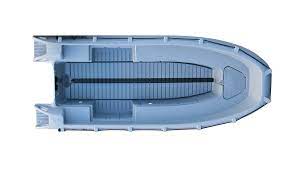
Built to take knocks without becoming a drama
Whaly moulds the 435 in high-grade polyethylene as a double-wall structure with internal foam. The material is colour-fast and impact tolerant, while the enclosed construction adds stiffness and reserve buoyancy. Pontoons, harbour walls and rough equipment are part of a working boat’s life. This hull is made for that life. A scrape does not become a week of staring at gelcoat and muttering about somebody else’s fender.
The form is broad enough to feel stable, with high sides and a clean interior that can be washed down after fishing, training or rescue work. There is no delicate lining to trap dirt and no decorative trim occupying the places where people need to stand. The standard boat can remain open and simple or take seating, rails and console equipment for a more specialised role. Its basic strength stays the same underneath.
Capacity that works in the real world
The CE category C figure of six people and 650 kilograms including the motor is the one I find most useful for exposed inshore conditions. Category D allows ten people and 860 kilograms in sheltered waters. Those are limits rather than loading targets, but they show how much reserve sits inside a compact hull. A club crew, dive team or family can bring equipment without every bag becoming an argument about the last available corner.
Standard maximum power is 30 horsepower, while reinforced professional configurations can be built for up to 40 horsepower. That gives the 435 two clear lives rather than one vague specification. A 30-horsepower Yamaha makes a sensible general-purpose package; the reinforced form takes the same tough hull idea into harder commercial duty.
Whaly 435 vs Rigiflex New Matic 400 vs Pioner 400 Steady vs Pioner 14 Active
| Utility boat | Boat price including VAT | Length, beam and weight | Published capacity | Outboard scope | Hard-use features |
|---|---|---|---|---|---|
| Whaly 435 | £3,617 | 4.35 × 1.73 m; 196 kg | CE D: 10 people and 860 kg; CE C: 6 people and 650 kg, motor included | 30 hp standard; selected reinforced forms up to 40 hp | Foam-filled double-wall polyethylene; high freeboard; open wash-clean layout; professional and rescue use |
| Rigiflex New Matic 400 | £4,450 | 4.00 × 1.78 m; about 165 kg | Published for 5 people | Up to 30 hp by model | Rotomoulded polyethylene; open work layout; shorter hull and lower published crew count |
| Pioner 400 Steady | £5,705 | 4.00 × 1.80 m; about 200 kg | CE C: 6 people | Up to 40 hp | Rotomoulded polyethylene; wide, stable shape; less length and a higher boat price |
| Pioner 14 Active | £6,285 | 4.11 × 1.73 m; about 220 kg | Up to 4 people by specification | Up to 25–30 hp by version | Leisure-focused modular fittings; lower crew figure and less working-room length |
Advertised boat prices and published specifications checked 11 September 2026. Engines, consoles, trailers and optional professional fittings are excluded unless stated by the seller.
The Whaly wins on the figures that carry people
Rigiflex offers another credible polyethylene workboat, but the New Matic 400 is shorter, carries a lower published crew count and costs more in the compared listing. The Pioner 400 Steady matches the Whaly’s six-person category C figure and can take 40 horsepower, yet it is shorter and over £2,000 dearer as a boat. The Pioner 14 Active is a smart leisure layout, though its lower crew and power figures place it in a different kind of day.
The 435 puts the strongest combination in one row: the longest hull here, a 196-kilogram weight, serious category C and D capacities, a foam-filled double wall and the lowest advertised boat price. That leaves room in the budget for the engine, console, rails or working equipment while keeping the core hull uncompromised. The saving is useful, but the reason to buy it is strength and carrying ability.
Commercial credibility helps the leisure owner too
Whaly boats are used for rescue, harbour, fishery and support work because they are stable, simple to clean and hard to intimidate. The same qualities make family ownership easier. Wet boots, crab pots and children do not alter the construction. The boat can take a beating, come ashore, wash out and return to the water without needing to be treated as something fragile.
Polyethylene also keeps the maintenance conversation straightforward. Fittings, drains and the outboard still need attention, but the hull finish is not asking for a polishing programme. That dependable working character supports resale as well: buyers looking for a Whaly generally understand why the boat looks purposeful and why commercial history matters.
Ciaran’s verdict
I would choose the Whaly 435 for any job that mixes people, gear and repeated launching. It is stable, exceptionally tough and generous in its published carrying figures. The open layout can be configured without losing the clear deck that makes it useful in the first place.
The alternatives have their own followings, but none combines this much capacity, impact-tolerant construction and price as convincingly. The 435 is safe, reliable and ready for a hard working life. Better still, it does not expect an apology when a wet rope lands aboard. View the Whaly 435 product page.
About this review
I based this review on the product and manufacturer information listed in the sources, together with advertised UK prices checked on 11 September 2026. It is an editorial assessment, not an instrumented performance, durability or sea test. The words and opinions are Ciaran Hughes’s, and the article was not written by Flood Marine Services.