A sealed charger that shows its working
A charger installed low in a boat has an unglamorous life. It sits near damp air, cold metal and the battery gases and grime that never appear in a clean workshop photograph. If it is going to stay aboard, I want the casing, the charging programme and the information available to the owner to make sense as one unit. The Victron Blue Smart IP67 12/13 does exactly that.
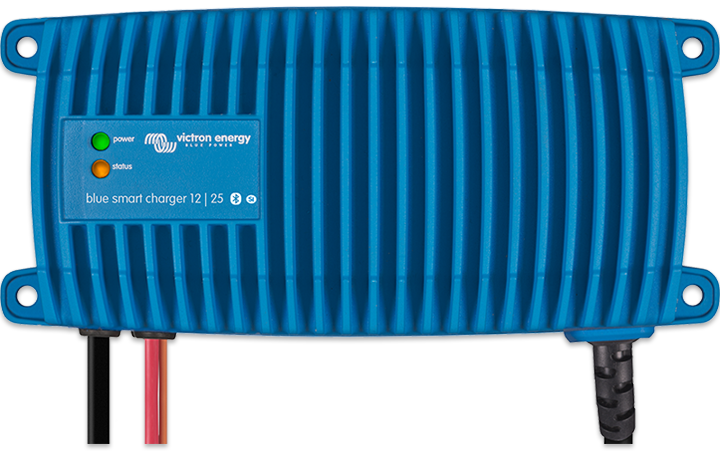
The UK single-output model costs £130 including VAT. It supplies up to 13 amps to a 12-volt battery from a 230-volt shore supply, reaches a published efficiency of about 93 per cent and carries a five-year warranty. The cast-aluminium case is fully encapsulated in resin, rated IP67 against dust and temporary immersion, and ignition protected. This is a charger designed to be installed in a difficult environment, not a workshop unit wearing a blue coat.

The sealed case changes where it can live
Many smart chargers are splash-resistant. Victron goes further by sealing the electronics in resin inside the aluminium housing. There is no cooling fan pulling damp air through the unit, and the finned case sheds heat without exposed ventilation slots. On a boat, that removes two common anxieties at once: moisture reaching the board and a small fan becoming another moving part.
IP67 does not mean the cables and connections can be left in standing water. It means the charger body has a high published level of ingress protection. The mounting position still needs air around the cooling fins, proper strain relief and clean battery connections. The difference is that the case itself is made for the environment rather than merely tolerated in it.
Ignition protection matters where batteries and fuel systems share confined spaces. It is one of those details a skim reader can miss because it does not change the amp number. In an installed marine charger, it is more important than a bright front display.
Charging that follows the battery
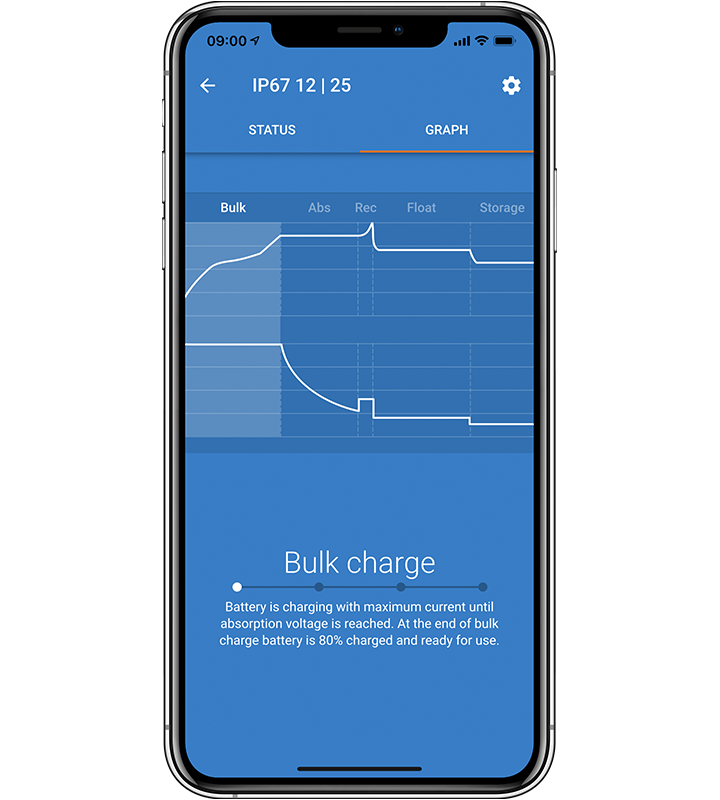
The Blue Smart uses an adaptive multi-stage programme. It moves through bulk and absorption, then reduces voltage for float and storage rather than holding a battery at an unnecessarily high level for weeks. A recondition mode can be selected for suitable lead-acid batteries, and there are profiles for common lead and lithium chemistries. Power-supply mode allows the charger to hold a steady direct-current output when that is the required job.
Victron also provides a recovery process for a deeply discharged battery. It begins with a small controlled current until the terminal voltage is high enough for normal charging. That does not promise to rescue a damaged battery; it gives a recoverable flat battery a structured route back into the programme.
At 13 amps, the charger sits in a useful place for medium domestic and starting banks. It has enough output to replace a meaningful overnight load without being a huge, hot box. Battery capacity, chemistry and the time available alongside still decide the correct size. I would rather see a 13-amp charger working within a sensible brief than a large amp claim attached to the wrong installation.
The phone becomes the front panel
Bluetooth connects the charger to VictronConnect. The app shows charging voltage and current, operating state, recent history and configurable settings. That information is particularly valuable when the charger is installed out of sight. An owner can see whether the battery is accepting charge without lifting a berth cushion and balancing a torch between two teeth.
The app also makes the unit easier to understand over time. A single green light can say that today is fine. History can show how often the charger reaches absorption, how long it remains there and whether a changed battery or load has altered the pattern. It turns charging from a mystery box into something that can be checked.
Victron Blue Smart IP67 12/13 vs CTEK M15 vs NOCO GENIUS10 vs Ring RSC612
| Battery charger | Price including VAT | Output | Environmental protection | Charging functions | Information and warranty |
|---|---|---|---|---|---|
| Victron Blue Smart IP67 12/13 | £130 | 12 V; 13 A; one output | IP67; fully encapsulated cast-aluminium housing; ignition protected | Adaptive stages; recondition, storage, power-supply and deep-discharge recovery; lead and lithium profiles | Bluetooth VictronConnect data, history and settings; 5-year warranty |
| CTEK M15 | £224 | 12 V; 15 A | IP44 splash protection; portable marine charger | Lead-acid and lithium modes; AGM and recondition programmes; temperature compensation | LED programme display; no Bluetooth app listed; 5-year warranty |
| NOCO GENIUS10 | £100 | 6/12 V; 10 A | IP65 dust and water-jet protection | Lead-acid and lithium profiles; repair mode; temperature compensation | On-unit indicators; no Bluetooth app; 3-year warranty |
| Ring RSC612 | £89 | 12 V; 12 A | No equivalent installed-marine IP rating stated in compared listing | Multi-stage charging; lead-acid, AGM and EFB modes; recondition function | LCD display and battery/alternator tests; no lithium or Bluetooth listed |
Advertised prices and published specifications checked 10 September 2026. Protection ratings apply to the charger body under the manufacturer’s test conditions; cable terminations and the installation remain separate.
The installation features are the value
CTEK supplies two more amps and a respected range of battery programmes, but at £94 more it has IP44 rather than the Victron’s sealed IP67 construction and does not provide the same phone-based history. NOCO is compact, covers 6- and 12-volt batteries and has good temperature management, yet its 10-amp output, IP65 case and three-year warranty stop short of the Victron’s installed-marine specification. Ring offers useful workshop tests and 12-amp charging, but the compared listing does not add lithium support, Bluetooth or an equivalent marine ingress rating.
The Victron is the only charger here that combines 13-amp output, a fully encapsulated ignition-protected case, adaptive storage behaviour, lithium and lead profiles, deep-discharge recovery, power-supply mode, Bluetooth history and a five-year warranty. That list matters because each item serves the same ownership idea: fit the charger aboard, leave it connected appropriately and still know what it is doing.
I would not buy it for the app alone. The reason to choose it is that the app is attached to the best-protected installation in the table. Information without a marine case is only half the job. A sealed case without clear information is better, but still makes diagnosis slower. Here the two sides meet.
My conclusion
The Blue Smart IP67 12/13 is a very well-judged boat charger. Thirteen amps covers a useful battery range, the charging stages look after both active and stored batteries, and VictronConnect makes an out-of-sight installation easy to read. The cast-aluminium, resin-filled body is the feature I would put first because it is the part that keeps doing its job in the damp.
There are larger chargers and cheaper chargers in the table. None joins marine protection, charging breadth, remote information and warranty as neatly at £130. For a permanent single-bank installation, this is the one that adds up. View the Victron Blue Smart IP67 12/13 product page.
About this review
Prices and specifications are based on manufacturer information and live advertised UK listings checked on 10 September 2026. This is an editorial assessment rather than an electrical-efficiency, ingress or battery-recovery test. The article was written by Neil Duddy as an independent editorial review and was not written by Flood Marine Services.