Four wheels make the last twenty metres easier
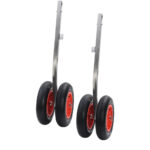
The boat is out of the water. The engine is raised. Then the launch wheels sink into shingle and the last few metres become the worst part of the day. Osculati’s 47.368.07 system fixes the problem in a very direct way: four large pneumatic wheels put more rubber on the ground and spread the load across two tyres on each side. Launch wheels will never be the glamorous part of the outfit, but glamour is not much help when the boat has planted itself in the stones.
The set is priced at £345 including VAT and has a published 240-kilogram rating. Each stainless-steel arm is 890 millimetres long and carries two 370-millimetre wheels. It is more hardware than a normal two-wheel set because it is built to do more. I would sooner move a loaded boat on four proper tyres than spend every recovery dragging two narrow ruts up the shore.

Four wheels solve the real problem
A two-wheel system puts roughly half the supported load through each tyre. Osculati divides it across four contact patches. On gravel, shingle, grass or sand, the wider footprint is less inclined to dig in. When one wheel meets a hollow or loose patch, another beside it keeps the transom better supported.
The difference is not limited to soft ground. Four wheels give the boat a steadier base on concrete and make it less likely to rock from side to side while being pushed or turned. The setup feels planted. That matters with a heavy inflatable, but it also makes a lighter tender easier to control when one person is moving it. It is difficult to look composed while fighting a boat that has decided to become garden furniture.
Wheel diameter is doing its share of the work too. A 370-millimetre tyre rolls over joints, stones and small edges that can stop a compact trolley wheel dead. Pneumatic tyres absorb some of the chatter instead of passing every sharp hit into the bracket and transom. Big tyres and four contact points are a sound combination.
The 240-kilogram rating leaves useful room
Small boats gain weight quietly. Add the outboard, fuel, battery, anchor, safety equipment and the gear left aboard, and a 200-kilogram launch-wheel limit begins to look close. Boats are very good at collecting equipment while nobody is looking. Osculati publishes 240 kilograms for this set, another 20 per cent above each alternative in the comparison. That margin is useful before the boat reaches anything like the top figure.
The load rating and the footprint improve different parts of the same job. One says what the hardware is designed to carry. The other decides how well that weight crosses the ground. Osculati leads on both. A two-wheel set cannot copy the four-tyre stance, regardless of how similar the brackets look in a photograph.
Long stainless arms give proper clearance
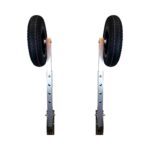
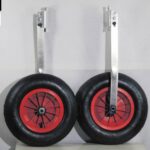
The 890-millimetre arms put the axles well below the transom, leaving the hull clear of the ground. Each side pivots up for launching and can be removed from its fixed bracket when the wheels are not wanted. Pins make the change simple, while the stainless-steel structure is well suited to repeated marine use.
The assemblies are substantial. They have to be. Four 370-millimetre pneumatic wheels and long arms cannot fold into the same space as a pair of small trolley wheels. In return, the boat gets ground clearance, stability and a system that is comfortable carrying a heavier outfit.
Osculati 240 kg launch wheels vs Boatworld Heavy Duty vs Ceredi/IBS 200 kg vs EasyFlip 200 kg
| Launching-wheel system | Price including VAT | Difference | Published rating | Wheel arrangement | Arm detail |
|---|---|---|---|---|---|
| Osculati 47.368.07 | £345 | — | 240 kg | Four 370 mm pneumatic wheels | Two 890 mm stainless-steel arms |
| Boatworld Heavy Duty | £220 | £125 less | 200 kg | Two wheels | Telescopic 620–800 mm |
| Ceredi/IBS Up-and-Over | £160 | £185 less | 200 kg | Two 14-inch solid polyurethane wheels | Stainless-steel arms |
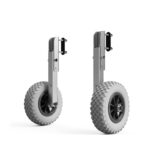
| EasyFlip Stainless | £129 | £216 less | 200 kg | Two puncture-proof wheels | Flip-up stainless-steel system |
Advertised prices and published ratings checked 8 September 2026. Prices refer to the compared complete wheel sets.
Why the Osculati earns the difference
The price gaps are plain, and so is what the Osculati adds. Every alternative stops at 200 kilograms and puts one wheel on each side. Osculati raises the published rating to 240 kilograms and doubles the number of tyres. It spreads the load more effectively, rolls on larger pneumatic wheels and gives the boat a noticeably steadier stance.
Boatworld offers telescopic adjustment, while the Ceredi and EasyFlip sets keep their two-wheel layouts simple. None of those details replaces the extra pair of 370-millimetre tyres or the additional 40 kilograms of published capacity. The Osculati is the only system in this group that improves carrying headroom and ground contact together.
That makes the higher figure sensible for far more than an unusually heavy workboat. A family inflatable is easier to control. A fishing tender loaded with fuel and equipment has proper capacity in hand. A boat that crosses shingle or rough ground gains the tyre area it needs every time. The benefit does not sit unused between difficult launches; four wheels remain more stable on the easy ones as well.
Fitting deserves a proper job
The brackets transfer the lifting and rolling load into the transom. A solid backing arrangement, suitable fasteners and a sealed installation let the long arms do their work properly. Position also matters because the raised legs need to clear the engine, steering movement, drain fittings and transducer.
Once fitted squarely, the system becomes part of the boat rather than something hanging from it. The axles sit low, the hull stays clear and the four tyres share the weight. The arms can remain raised for short trips or come away from the brackets when storage matters. Rinse salt and grit from the pivots, keep the tyres at the right pressure and the working parts are easy to see.
Ciaran’s verdict
There is no mystery here. Four large wheels carry and control a boat better than two smaller contact points. Add the 240-kilogram rating and long stainless arms, and the Osculati 47.368.07 is built for the full shore-handling job rather than the easiest bit of a concrete slip.
My choice is the Osculati because the extra money buys visible, useful engineering: twice the tyres, 20 per cent more published capacity and a stable footprint that works on firm, rough and soft ground. It is the set most likely to make the last twenty metres feel ordinary. View the Osculati 240 kg launch wheels.