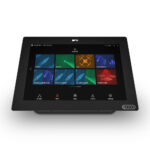
A bright, wet-weather screen that stays easy to use

Bright sunlight and rain create opposite problems at the same helm. One washes detail out; the other covers the glass in water and fingerprints. The Raymarine Axiom+ 12 is unusually good at both. Its 1,800-nit in-plane switching display is very bright, and the HydroTough coating is designed to shed water, oil and smudges rather than collecting them over the chart.
The display-only model is currently £2,342 including VAT. Compatible network sonar, radar, cameras and instruments can be added through the LightHouse system. I would choose it for the screen first, then build the sensors around the boat’s work. That keeps the helm clean and gives each part of the system a clear purpose.
The screen remains readable from more than one seat
The 12-inch panel has a resolution of 1280 by 800 pixels and wide viewing angles. Crew seated beside the helm can read the chart without leaning across the driver, and the brightness gives day palettes enough contrast in direct light. At night, LightHouse provides subdued colour choices that preserve useful information without turning the cockpit into a shop window.
HydroTough is not a glamorous specification until spray reaches the screen. The coating helps water bead and reduces greasy marks, while the bonded IPS panel keeps contrast consistent. Touchscreens still reward a clean hand and sensible page size, but the Axiom+ starts with a surface designed for the environment in front of it.
LightHouse keeps a large system approachable
Raymarine’s LightHouse operating system uses clear application icons and configurable dashboards. Charts, radar, automatic identification system targets, instruments and cameras can be arranged as full or split pages, then recalled quickly. The quad-core processor keeps movement and chart redraw responsive, while 16 gigabytes of internal storage holds personal data and applications.
RayNet carries radar, sonar and other high-bandwidth information between compatible units. SeaTalkNG provides the physical route to National Marine Electronics Association (NMEA) 2000 instruments and sensors, and Wi-Fi supports updates, mobile control and related services. ClearCruise augmented-reality functions can combine a compatible camera feed with navigation marks. That is a specialist addition, but it shows how far the platform can expand.
Raymarine Axiom+ 12 vs Lowrance HDS PRO 12 vs Simrad NSX 3012 vs B&G Zeus S 12
| Twelve-inch multifunction display | Price including VAT | Screen in sun and spray | Operating approach | System connections | Best reason to choose it |
|---|---|---|---|---|---|
| Raymarine Axiom+ 12 | £2,342 | 1,800-nit 1280 × 800 IPS display; HydroTough water- and smudge-repellent coating | LightHouse operating system; touch-led pages; quad-core processing | RayNet, SeaTalkNG/NMEA 2000, Wi-Fi; radar, cameras, instruments and network sonar | Exceptional brightness and wet-screen treatment in a mature Raymarine system |
| Lowrance HDS PRO 12 | £2,477 | 12-inch 1280 × 800 SolarMAX HD touchscreen; over 1,200 nits | Touchscreen plus four programmable shortcut keys | Ethernet, National Marine Electronics Association 2000, Wi-Fi, radar and sonar expansion | Fishing-led multifunction display with broad sonar options |
| Simrad NSX 3012 | £2,899 | 12-inch SolarMAX IPS touchscreen | NEON interface with guided setup and custom activities | Ethernet, NMEA 2000, Wi-Fi, Simrad radar and Mercury integration | Strong C-MAP powerboat system with sonar capability |
| B&G Zeus S 12 | £3,199 | 12-inch sunlight-viewable touchscreen | Sailing-first pages, routes and layline tools | Ethernet, NMEA 2000, Wi-Fi and B&G instruments | Purposeful choice for a sailing yacht and wind-led navigation |
Advertised prices and manufacturer specifications checked 11 September 2026. The Axiom+ and Lowrance models compared are supplied without a transducer; charts, sonar hardware and network accessories vary by installation.
Why Axiom+ is the stronger mixed-use screen
Lowrance’s HDS PRO 12 costs more and puts its emphasis on fishing, with an internal sonar platform, four programmable keys and a clear path to Active Imaging and ActiveTarget hardware. Simrad’s NSX adds its own sonar and Mercury strengths, while B&G gives sailors dedicated wind and layline tools. Those are useful specialisms, but they do not make the screen easier to read in a hard shower.
My reason for choosing Axiom+ is more immediate. Its published 1,800-nit brightness is well above the Lowrance figure, HydroTough tackles water and finger marks, and LightHouse keeps the pages composed when chart, radar and instruments share the display. It is also the least expensive of these four current listings. For a mixed power or cruising boat, that balance is stronger than paying extra for fishing or sailing functions that are not the main job.
Erin’s verdict
I would buy the Axiom+ 12 for its visibility first and its system depth second. The 1,800-nit panel, wide angles and water-repellent surface solve problems that appear on nearly every trip. LightHouse then provides a straightforward route into radar, cameras, instruments and network sonar without making the home screen feel technical.
Lowrance, Simrad and B&G each lean harder into a specialist fishing or sailing brief. My choice for a clear, calm mixed-use helm is the Axiom+ 12. Its screen treatment earns its keep every time sun or spray lands across the glass, and the network can grow well beyond the first installation. View the Raymarine Axiom+ 12.
I also like the way the physical screen specification supports the software. Wide viewing angles matter when a second person is watching a route, and the coating matters when the first shower leaves the glass dotted with water. Neither feature sounds dramatic on shore. Together they reduce the small distractions that make a busy helm feel busier than it is.
About this review
I based this review on the product and manufacturer information listed in the sources, together with advertised UK prices checked on 11 September 2026. It is an editorial assessment, not an instrumented performance, durability or sea test. The words and opinions are Erin McKee’s, and the article was not written by Flood Marine Services.