Protection that earns the extra spend
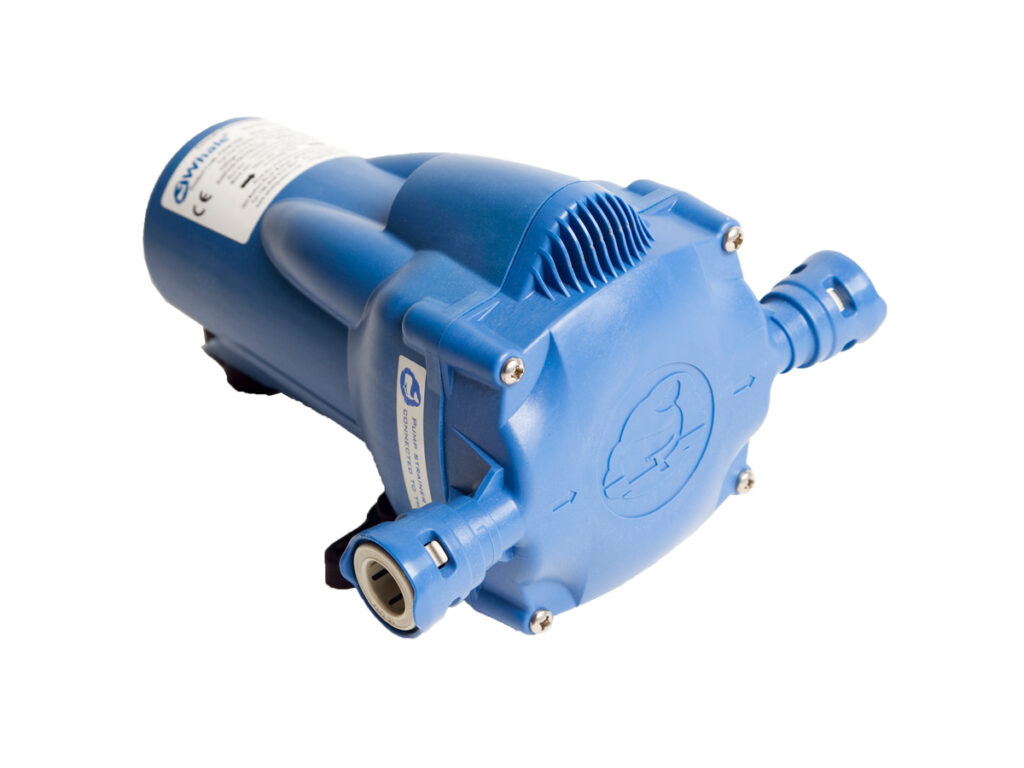
A fresh-water pump usually hides in the locker nobody wants to open. Then a tap splutters, the pump cycles or a fitting needs checked, and suddenly that locker becomes the centre of the day. I judge a pressure pump by the job it saves me later. The 12-volt Whale Watermaster FW0814 delivers eight litres per minute at a 30 pounds per square inch (psi) cut-off, and its real strength is how neatly the protection, plumbing and mounting details support that modest one- or two-outlet system.
At £158, this is not the lowest-priced pump in the comparison. I still rate it as the strongest overall buy for a small galley, heads basin or compact workboat water circuit. Whale gives me a three-metre self-priming lift, an official Ingress Protection rating of IP67 for the sealed motor housing, an included inlet strainer and a five-amp fuse requirement around a published four-amp draw. Those figures matter when the tank sits low, the cable run has to stay tidy and spare electrical capacity is not lying about waiting for employment.
The right flow for a small marine system
Eight litres per minute is a sensible rate for one or two outlets. I get enough flow for washing hands, rinsing cups or filling a kettle without building the system around a larger pump than the job needs. The 30-pound pressure sits in familiar territory for marine taps and showers, and the automatic pressure switch starts and stops the pump as demand changes. I would size the hose, fuse and wiring to the installation guide, then confirm every joint under pressure before closing the locker. Fresh water can find a loose fitting with the enthusiasm of a spaniel finding mud.
The three-metre self-prime figure is especially useful. It gives me more freedom to place the pump above or away from the tank than the 1.8-metre figures published for two of the alternatives. I would still keep the suction run short, direct and airtight because a strong published lift is not permission for untidy pipework. The Watermaster can run dry without damage, which is valuable when a tank empties or air enters during commissioning, but I would treat that as protection for a real event rather than an operating routine.
Fitting it without inventing extra work
Whale supports both 15-millimetre Quick Connect plumbing and half-inch threaded connections. That gives me a clean route into a new Whale system and a practical route into existing pipework. The inlet strainer is part of the pump package, so the basic protection against tank debris is not left off the parts list. Three rotating feet help align the body with the available mounting face. The awkward locker is always spacious on the drawing, of course, but movable feet are still a proper advantage when the screwdriver finally meets reality.
The current Whale specification lists an IP67 sealed protective motor housing with the pressure switch integrated inside. It also lists Conformité Européenne (CE) certification, International Organization for Standardization (ISO) 8846 and ISO 10133 compliance, and American Boat and Yacht Council (ABYC) H-23. I read that as a product designed around the marine installation rather than a general pump merely invited aboard. The Flood Marine listing also identifies glass-filled polypropylene and polybutylene terephthalate in the body, nitrile seals, stainless-steel fasteners and Monprene in the feet, diaphragm and valves. Those material choices are relevant around vibration, damp and repeated cycling.
I like that the pump remains serviceable as a simple system component. The strainer can be inspected, the connections are accessible, and the mounting can be planned so the body is not buried behind a battery or a week’s worth of stores. I would leave enough hose movement to remove the unit and enough cable to test voltage at the pump. A pump that demands a yoga lesson at every service interval has missed the point.
Whale Watermaster FW0814 vs Jabsco Par-Max 3 vs Albin WPS 2.6 vs SHURflo Aqua King II Standard 3.0
| Model | Current UK price | Difference vs Whale | Rated flow and cut-off | Self-prime | Electrical demand | Marine protection | Connections and inlet protection | Installation and ownership |
|---|---|---|---|---|---|---|---|---|
| Whale Watermaster FW0814 | £158 | — | 8 litres/min; 30 psi | 3 m | 4-amp rated draw; 5-amp fuse | IP67 sealed motor housing; CE; ISO 8846 and ISO 10133; ABYC H-23 | 15 mm Quick Connect or 1/2-inch threaded; inlet strainer included | Three rotating feet; run-dry capable; intended for 1–2 outlets |
| Jabsco Par-Max 3 31395-2512-3A | £117 | £41 less | 11 litres/min; 25 psi | 1.8 m | 5.2-amp rated draw; 10-amp fuse | Enclosed motor; ISO 8846 ignition protection | Quick-connect fittings and inline strainer included | Vibration-isolating mounts; run-dry capable; 3-year warranty |
| Albin WPS 2.6 12V | £105 | £53 less | 10 litres/min; 40 psi | 3 m | 10-amp fuse | Heavy-duty sealed pressure switch | Quick-connect ports for 1/2-inch hose; 40-mesh strainer included | Three-chamber pump; smooth flow; intended for up to 3 outlets |
| SHURflo Aqua King II Standard 3.0 | £140 | £18 less | 11.35 litres/min; 30 psi | 1.82 m | 6.5-amp maximum; 7.5-amp fuse | Sealed motor and switch; thermal and ISO 8846 ignition protection | 13 mm hose or 15 mm push-fit connection | Four chambers; built-in check valve; run-dry capable; 3-year warranty |
The Jabsco advertises 11 litres per minute for £41 less, but its 25-pound cut-off, 1.8-metre prime, 5.2-amp draw and ten-amp fuse make a different installation. The Albin is £53 less and matches the Whale’s three-metre prime while raising flow to ten litres and pressure to 40 pounds, yet its ten-amp fuse and three-outlet brief move it away from the lean one- or two-outlet circuit I am assessing. The SHURflo is the closest pressure match and costs £18 less, with 11.35 litres per minute and a three-year warranty, though its published self-prime is 1.82 metres and maximum draw is 6.5 amps. The Whale brings the lowest stated current demand, the joint-deepest prime, the current IP67 housing, included strainer, flexible connection choices and rotating feet into one small-system installation. That is why I put it first overall: the extra purchase price buys useful margin in siting, electrical load and protection every time the pump is fitted or revisited.
Living with the pump
A two-year manufacturer warranty supports the ownership case, but my routine still matters. I would clean the strainer, check hose clips or push-fit engagement, inspect the fuse and wiring, and drain or winterise the system according to the boat’s use. If an accumulator is added, Whale advises setting its pressure below the pump cut-off. I would also listen for a change in cycling because the sound of a pressure system often tells me about a leak or restriction before the locker does.
The salt-water compatibility adds flexibility for a rinse or utility circuit, provided every other component is suitable and the system is flushed and maintained for that duty. For normal domestic fresh water, I see the FW0814 as a tidy match for small boats, day boats, angling craft and commercial cabins with limited outlets. It is not trying to feed a long line of showers. It is built to make a compact system dependable and straightforward to rig.
My verdict
I would buy the Whale Watermaster FW0814 for a one- or two-outlet marine system where current draw, self-priming height and installation access matter as much as headline flow. The rivals publish bigger litres-per-minute figures, but the Whale gives me the better all-round fit: three-metre prime, five-amp fuse, current IP67 housing, included strainer, two connection routes and feet that rotate to suit the space.
That is £158 spent on the parts of the job I expect to appreciate after the locker door closes. Firm choice. See the exact Whale Watermaster FW0814 at Flood Marine.
About this review
Specifications and prices were checked against the live Flood Marine listing, current Whale material and the named current UK competitor listings on 28 September 2026. It is an editorial assessment rather than an instrumented performance test, durability test or sea test. The independent reviewer is Ciaran Hughes, and the article was not written by Flood Marine Services.