The handheld I would want clipped on when the weather turns
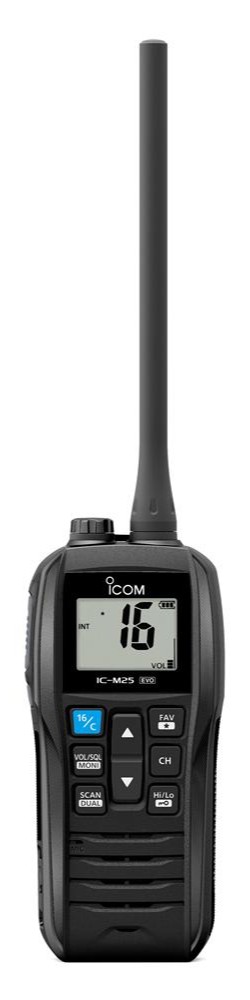
At the helm, a handheld very high frequency (VHF) radio earns its place in the few seconds after something changes. The engine has stopped, visibility has closed in or the radio has slipped from a wet glove. I want the controls to be obvious, the speaker loud enough to understand and the set easy to recover if it goes overboard. The Icom IC-M25 EVO has been designed around those ordinary moments of pressure.
The black set costs £184 including VAT and charges through USB-C. It transmits at up to 5 watts, delivers 700 milliwatts of audio and weighs 228 grams. It floats, flashes and sounds an alarm in the water. I can read those as specifications, but together they describe something more useful: a radio that is light enough to keep on the person and conspicuous enough to find again.

The best safety feature is the one that helps twice
Icom’s Float’n Flash system activates when the set enters water. The radio remains afloat, its light flashes and an audible alarm gives another clue to its position. A dark radio in dark water can vanish surprisingly quickly, even beside the boat. Light and sound make recovery less dependent on somebody keeping a perfect eye on the splash.
Once it is back aboard, AquaQuake vibrates water away from the speaker grille. The function does not magically dry the whole radio; it deals with the part that needs to move air clearly. That distinction makes sense to me. Waterproofing keeps water out of the case, flotation helps retrieve the set, and speaker draining helps restore intelligible audio. Three stages, each doing its own job.
The housing carries an IPX7 rating, meaning the published protection covers temporary immersion under the test conditions. The optional HM-165 floating speaker microphone can keep the radio clipped somewhere secure while putting audio and push-to-talk control closer to the user. On a small open helm, the radio itself is compact enough to work well without it.
It is comfortable enough to stay with you
At 228 grams and 31.2 millimetres deep, the M25 EVO is noticeably less of a lump than many commercial handhelds. The grip texture has been revised and the buttons are large. Channel 16 has its own control, while volume, squelch, scanning and dual-watch functions sit where they can be found without walking through a menu tree.
The display is large for the body and uses clear status symbols. Icom has resisted turning the front into a tiny multifunction display. That is the correct decision. A safety radio should not ask its owner to remember which of six soft keys was feeling important last Tuesday.
USB-C charging is another everyday improvement. A full charge takes roughly three hours with a suitable supply, and Eco mode extends quoted operating time to about 14 hours by reducing transmit power to 2.5 watts. Full power remains available when range and conditions call for it. Being able to use a familiar charging cable in the car, cabin or power bank removes one proprietary cradle from the kit bag.
Icom IC-M25 EVO vs Standard Horizon HX210E vs Cobra HH150 vs Entel HT644
| Handheld marine radio | Price including VAT | Transmit and audio | Water recovery | Battery and charging | Handling |
|---|---|---|---|---|---|
| Icom IC-M25 EVO | £184 | 5 W transmit; 700 mW speaker | IPX7; floats, flashes and sounds an alarm; AquaQuake speaker draining | About 14 h in Eco mode; USB-C charge in about 3 h | 228 g; large screen and keys; textured grip; optional floating speaker microphone |
| Standard Horizon HX210E | £110 | 6 W transmit; 600 mW speaker | IPX7; floats with water-activated emergency strobe | 1,850 mAh battery; roughly 3 h desktop charging | About 280 g; dedicated controls; broadcast receiver |
| Cobra HH150 | £75 | 3 W transmit | IPX7; floating design with orange core | Five rechargeable AAA cells; 12 V charging lead | Compact controls and illuminated display |
| Entel HT644 | £191 | 5 W transmit; commercial-grade audio | IP68 submersible; does not float without an accessory | 2,000 mAh battery; about 12.5 h stated; desktop charger | About 330 g in retailer specification; MIL-STD construction; commercial controls |
Advertised prices and published specifications checked 10 September 2026. Battery-life tests, supplied charging equipment and water ratings follow each manufacturer’s stated conditions.
One radio joins the useful details together
Standard Horizon gives 6-watt transmission, flotation and a strobe at a lower figure. Cobra covers basic floating emergency communication, though its 3-watt output, replaceable-cell arrangement and simpler recovery features put it in a different class. Entel is the rugged commercial option, with IP68 protection and a substantial battery, but the compared set is heavier and does not float on its own.
The Icom sits between leisure convenience and professional sense. It is the lightest quoted set in this table, has the strongest published speaker output, charges through USB-C and combines flotation with both visual and audible recovery aids. AquaQuake then deals with the wet speaker after retrieval. No rival shown here puts that exact chain into one 228-gram radio.
What decides it for me is the sequence shown in the table. The M25 EVO is not asking for trust because of the name on top. Its features follow a real problem from start to finish: keep transmitting, be heard, survive the drop, be found, clear the speaker and get back on charge without hunting for a dedicated dock.
The one I would carry
I would keep the Icom IC-M25 EVO clipped to my lifejacket or within immediate reach at the helm. It is light, clear and pleasantly uncomplicated. The large controls are sensible in wet hands, 700-milliwatt audio helps a call cut through cockpit noise, and USB-C makes it easier to keep the battery ready.
The clever part is not any one headline. Flotation, flash, alarm and AquaQuake work as a sequence, and the radio remains small enough to be carried rather than left in a locker. That makes the M25 EVO the most complete handheld in this comparison. View the Icom IC-M25 EVO product page.
About this review
Prices and specifications are based on manufacturer information and live advertised UK listings checked on 10 September 2026. This is an editorial assessment rather than a transmission-range, immersion or battery-duration test. The article was written by Erin McKee and was not written by Flood Marine Services.