The Clearer View of a Working Battery Bank
At the helm after dark, I want the battery screen to answer a small set of important questions without making me decode the electrical system. Is the domestic bank charging, what is leaving it, how much is left and how long will it last at the present rate? The NASA Clipper BM-1 24V answers all four on a clear backlit display, and the reviewed 24-volt model costs £124.
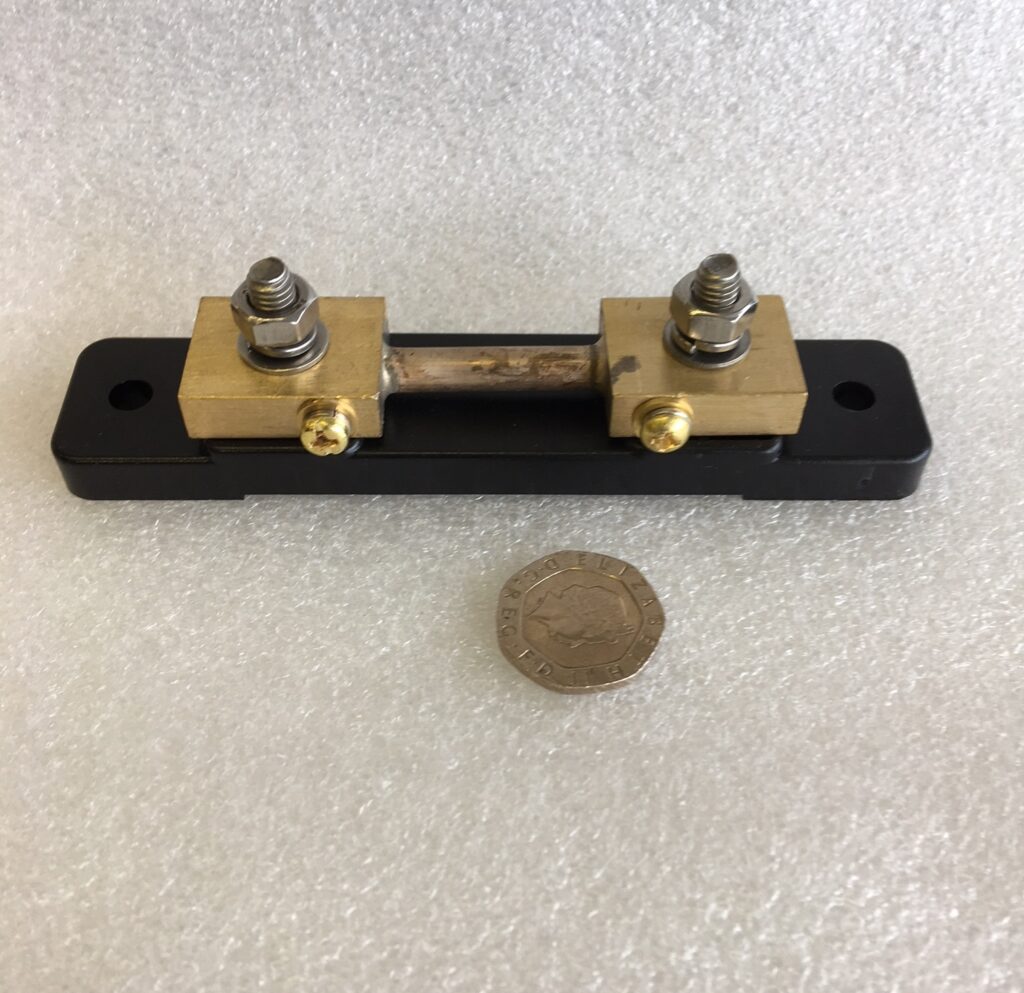
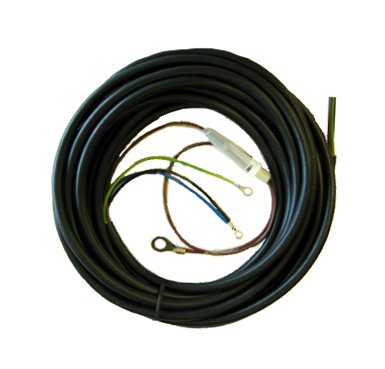
This is a shunt-based monitor for 24-volt lead-acid banks from 5 to 600 ampere-hours (Ah). Its supply range is 16–32 volts direct current (DC), and it measures charge or load current up to 100 amperes (A). The package includes the 100-amp, 50-millivolt shunt, a shunt link and a fitted five-metre cable. I see that complete kit as part of the value because the monitor, measuring point and cable are specified to work together.
What the screen tells me
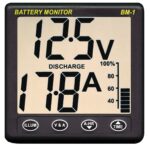
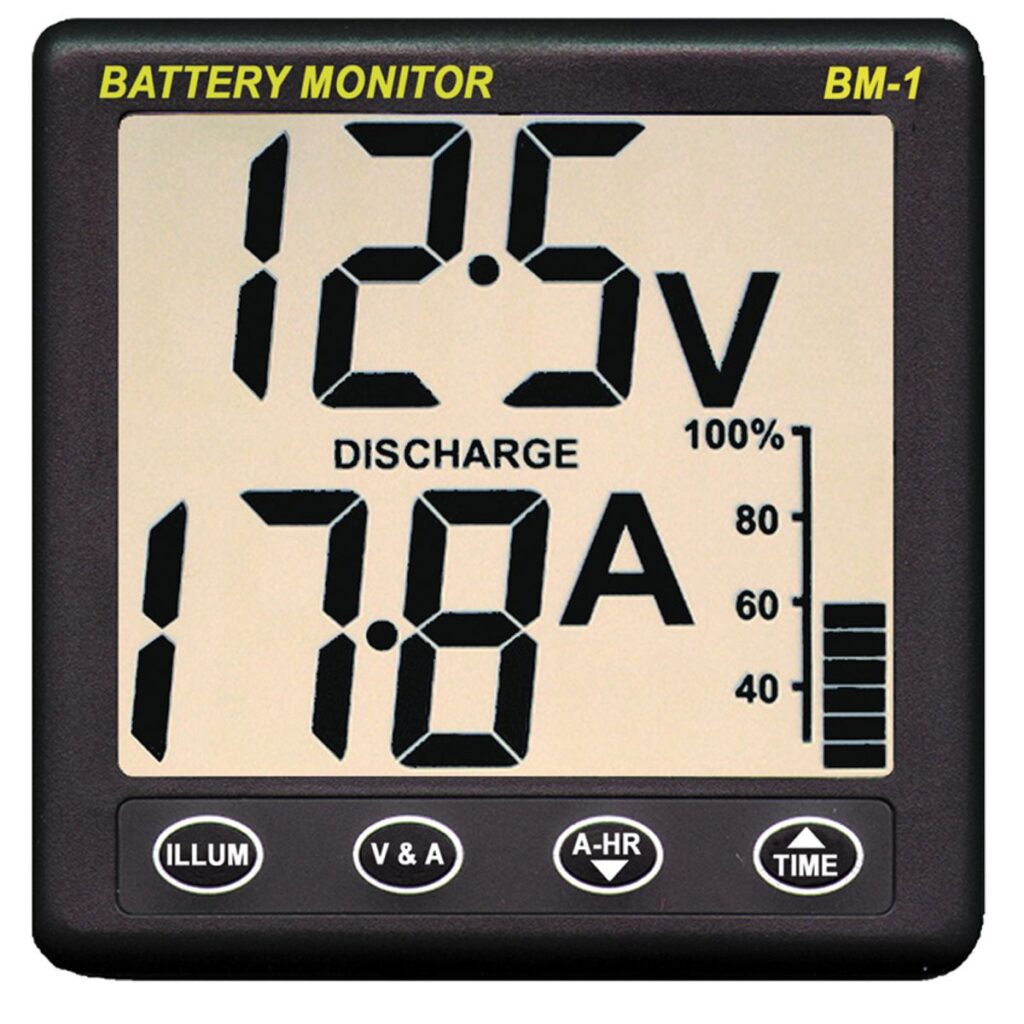
The display presents service-bank voltage, current flowing in or out, accumulated ampere-hours, state of charge and time to charge or discharge. I can select the view with four keys, use the backlight at night and see a visual warning when voltage is low. There is also an input for the engine-start battery voltage, so one panel can keep the domestic bank in detail and the starting supply in sight.
That combination is more useful than voltage alone. Battery voltage changes with load and charging, so the same reading can mean different things at different moments. By measuring current across the shunt as well, the BM-1 can show whether the bank is gaining or losing energy and calculate remaining time at the present rate. I still interpret the figure in context: switching on a fridge or inverter changes the time estimate because the boat has changed the question.
The high-contrast liquid-crystal display (LCD) sits in NASA’s familiar 110-millimetre square Clipper case. I like the generous face because battery information is usually checked while doing something else. The published supply current is only 1.5 milliamps, which is notably low for a panel left operating throughout a cruise. Clear digits and modest consumption are quiet virtues. Neither needs a dramatic menu animation to prove its worth.
Installation and commissioning
The shunt belongs in the domestic bank’s negative return so the monitored loads and charging sources pass through it. I would keep only the intended battery-side connection on the battery end of the shunt, then route system negatives through the load side according to the manual. A missed negative path can bypass measurement and make an otherwise tidy display tell an incomplete story.
The supplied cable is five metres long, fused and fitted with the relevant ring terminals. That reduces fabrication at the panel, though I would still plan the run before cutting the 110-millimetre opening. I want the screen visible from the normal helm position, the cable protected from chafe and the shunt accessible for inspection in a dry, ventilated electrical area. Commissioning also means entering the actual bank capacity and checking charge and discharge direction.
I would treat the state-of-charge and remaining-time figures as navigation aids for the electrical system, not excuses to ignore the bank. Battery capacity changes with age, temperature, discharge rate and charging history. A sensible owner compares the display with known loads, charging behaviour and periodic battery checks. The monitor earns trust by helping me notice a changed pattern early.
NASA Clipper BM-1 24V vs Mastervolt BattMan Lite vs Merlin SmartGauge vs Balmar SG200
| Battery monitor | Current UK price | Difference vs NASA | System range | Bank and current capacity | Readings | Second-bank view | Display and consumption | Shunt and cable | Useful extra |
|---|---|---|---|---|---|---|---|---|---|
| NASA Clipper BM-1 24V | £124 | — | 24-volt lead-acid; 16–32-volt supply | 5–600 Ah; 100 A charge or load | Voltage, current, Ah, state of charge and time | Starter-battery voltage input | 110 mm square backlit LCD; 1.5 mA | 100 A / 50 mV shunt and fitted 5 m cable included | Low-voltage visual alarm; four-key operation |
| Mastervolt BattMan Lite | £148 | £24 more | 12/24-volt; 9–35-volt supply | Up to 9999 Ah; 500 A shunt | Voltage, current, Ah and capacity percentage; no time remaining | Starter-battery voltage input | 64 mm round Ingress Protection (IP) 65 display; 6 mA at 24V unlit | 500 A / 50 mV shunt; six-wire cable required | Potential-free battery-alarm contact |
| Merlin SmartGauge | £120 | £4 less | 12/24-volt; 8–40-volt range | Algorithmic state of charge; no current shunt | Main-bank voltage and percentage remaining | Second-battery voltage input | Light-emitting diode (LED) display; 5 mA sleep current | No shunt; three-wire installation | High/low voltage and low-capacity alarms; split-charge interface |
| Balmar SG200 | £302 | £178 more | 12/24/36/48-volt; 8–60-volt supply | Up to 1250 Ah; 350 A continuous | Voltage, current, state of charge, state of health, time and history | Two auxiliary voltage-sense lines | Colour IP65 display; 10 mA sleep at 12V | SmartShunt and 10 m communications cable included | Expandable network; optional Bluetooth gateway |
Mastervolt costs £24 more and handles far larger banks and current through a 500-amp shunt, but its Lite display omits remaining time and draws 6 milliamps at 24 volts with the backlight off. Merlin is £4 less and its three-wire, shunt-free installation is neat, yet it does not show charge or discharge current, counted ampere-hours or remaining time. Balmar adds state of health, history, a colour display, 350-amp continuous measurement and network expansion, though its £302 price is £178 higher. I put NASA first for this defined 24-volt, 100-amp job because it is the only option at this price that combines measured current, ampere-hours, state of charge, time remaining, starter voltage, a large backlit display and the shunt plus five-metre cable in one low-consumption package.
A straightforward fit for a 24-volt boat
The central buying decision is fit. I would choose this model for a 24-volt lead-acid domestic bank no larger than 600 ampere-hours, where charge and load paths remain within the 100-amp rating. That covers a useful range of sailing boats, motor cruisers and workboats with conventional domestic systems. If the installation carries higher continuous current, the electrical design needs a monitor and shunt rated for that current rather than wishful arithmetic.
I also value the Clipper format when other NASA instruments are already aboard. The square face is easy to recognise, the controls are direct and the display can be read without opening a phone. There is no networking layer to commission. For a skipper who wants the essential battery picture at the panel, that restraint improves usability.
My verdict
I would choose the NASA Clipper BM-1 24V at £124 for a correctly rated 24-volt lead-acid bank. Its 1.5-milliamp draw, 100-amp shunt, five-metre fitted cable and large backlit display make the installation understandable, while voltage, current, ampere-hours, state of charge and remaining time give me a complete daily view. See the exact NASA Clipper BM-1 24V battery monitor at Flood Marine.
About this review
Specifications and prices were checked against the live Flood Marine listing, current official NASA Marine, Mastervolt, Merlin and Balmar material, and the named UK competitor listings on 2 October 2026. The work is an editorial assessment, not an instrumented performance, durability or sea test. Erin McKee is the independent reviewer; the article was not written by Flood Marine Services.