Simple hull support without the recovery circus
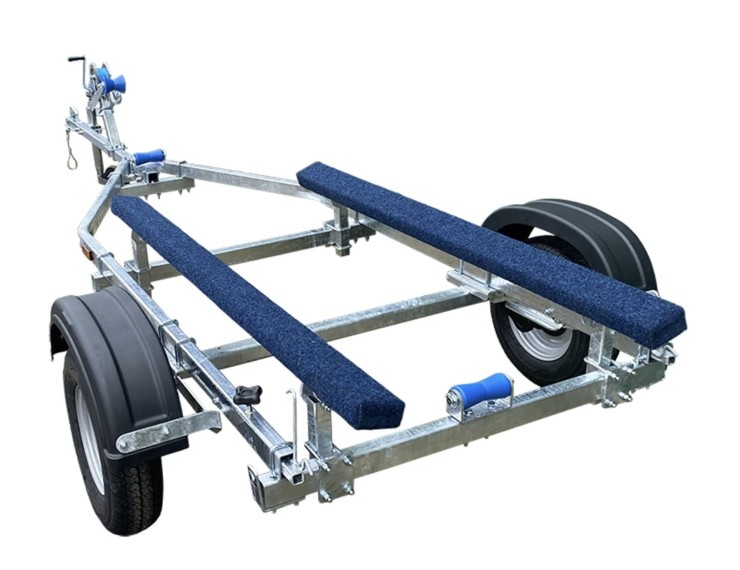
A boat trailer begins its working day when everybody else is ready to go home. The boat is wet, the wind has moved across the slip and the person holding the bow line has suddenly developed several opinions. A good bunk trailer keeps that scene short. The Extreme EXT500 does it with long adjustable support, a sensible payload and recovery gear that is already part of the specification.
It costs £1,530 including VAT. The gross limit is 500 kilograms, the trailer weighs 125 kilograms and the published boat allowance is 375 kilograms. Those three figures belong together. I would never match a trailer from the bare hull weight alone, because engines, batteries, fuel and the collection of equipment hiding in lockers are remarkably good at gaining weight.
The bunks support length rather than isolated points
Two 1.6-metre bunks spread support along the hull, with heavy-duty keel rollers carrying the centreline where the shape requires it. Bunks suit many inflatables and modest hard boats because they hold the hull steadily during storage and road travel. Every element is adjustable, allowing the height, angle and fore-and-aft position to follow the actual hull instead of asking the boat to tolerate a generic setup.
The winch post adjusts as well, so bow-eye position and nose weight can be set as part of the finished package. Extreme lists dinghies up to 15 feet with overhang, hard boats up to 12 feet and rigid inflatable boats (RIBs) up to 4.3 metres. Those are useful starting guides; the 375-kilogram loaded-boat allowance remains the figure that closes the discussion.
Extreme EXT500 Bunk vs SBS R2/500B vs Brenderup 8116B vs Maypole MP6808
| Bunk trailer | Price including VAT | Gross and boat payload | Hull support | Published boat fit | Road and recovery equipment |
|---|---|---|---|---|---|
| Extreme EXT500 Bunk | £1,530 | 500 kg gross; 125 kg trailer; 375 kg boat | Two adjustable 1.6 m bunks plus heavy-duty keel rollers | Dinghies to 15 ft with overhang; hard boats to 12 ft; RIBs to 4.3 m | Sealed bearings; 10-inch wheels; 48 mm jockey; 1,000 lb winch; extending light board |
| SBS R2/500B | £1,699 | 500 kg gross; published payload around 350 kg | Conventional paired bunks with fewer published adjustment details | Small dinghies and RIBs in the 500 kg class | Galvanised chassis and standard road gear; dearer while giving no payload advantage |
| Brenderup 8116B | £1,645 | Class-dependent gross figure; payload follows specification | Longitudinal bunks and keel support | Compact hard boats and inflatables | Established modular trailer range; exact jockey, winch and light-board equipment varies |
| Maypole MP6808 | £1,295 | 500 kg gross; about 350 kg payload by listing | Mixed roller and bunk support on a lighter specification | Small boats in the 500 kg class | Lower price; fewer heavy-duty standard fittings listed than the Extreme |
Advertised prices and published specifications checked 11 September 2026. Payload is the complete ready-to-tow boat allowance, including engine, fuel, battery and fixed equipment, not the bare hull figure.
The standard equipment saves later additions
Waterproof sealed bearings, 10-inch wheels, a 48-millimetre jockey wheel, 1,000-pound winch and light board on extending bars all arrive on the EXT500. None is exotic. That is exactly the point. They are the pieces used on every launch and recovery, and having them specified together reduces the collection of small upgrades that can make a cheap trailer dear by the time it is fit for work.
The fully galvanised UK-made frame is intended for repeated launch use. Fresh-water rinsing and normal inspection still matter around the hubs, tyres, straps, lights and fasteners. As an unbraked model, it also avoids the extra servicing attached to a braked axle. The sealed bearings reduce water ingress risk; they do not turn a wheel hub into a submarine. Sensible maintenance remains simpler than recovering a failed bearing from the roadside.
Why the EXT500 is the better finished trailer
Across this group, the Extreme has the strongest mix of useful payload, long bunk support and standard recovery gear. SBS asks more money while publishing no extra gross capacity and roughly 25 kilograms less boat allowance. Its listing also gives less detail on bunk length and included equipment. There is no payload or fitting gain to explain the higher figure.
Brenderup comes closer on price, but the precise standard kit needs matching carefully. Maypole costs less and gives away payload and heavy-duty equipment in return. I would put the EXT500 under the boat because its 375-kilogram allowance, 1.6-metre bunks, keel rollers and recovery equipment all strengthen the same package. The comparison does not depend on finding one flattering number.
Ryan’s verdict
The EXT500 Bunk is the trailer I would choose for a modest rigid inflatable boat (RIB) or hard boat that suits longitudinal support. Its 375-kilogram payload is clear, the 1.6-metre bunks can be set to the hull and the winch, jockey wheel, sealed bearings and extending light board make the base trailer ready for normal use.
The figures also leave little room for sales fog. SBS is dearer and carries less. Maypole saves money but gives up payload and specification. Brenderup comes closest, yet the Extreme’s known equipment and adjustability form the cleaner package. Set it up properly once and recovery becomes a routine rather than the evening entertainment. View the Extreme EXT500 Bunk.
About this review
I based this review on the product and manufacturer information listed in the sources, together with advertised UK prices checked on 11 September 2026. It is an editorial assessment, not an instrumented performance, durability or sea test. The words and opinions are Ryan Kerr’s, and the article was not written by Flood Marine Services.