A complete two-bank charging kit
A fixed solar kit changes the way a boat is used long before it pays back a calculation on paper. The battery is being supported while the boat sits on its berth, the fridge or instruments have a more sensible energy budget, and the engine is not started simply to replace a modest overnight draw. I see the value in the Solar Technology 100W Rigid MHD kit because the panel, controller, mounts and installation pieces have been selected as one permanent roof-or-deck package.
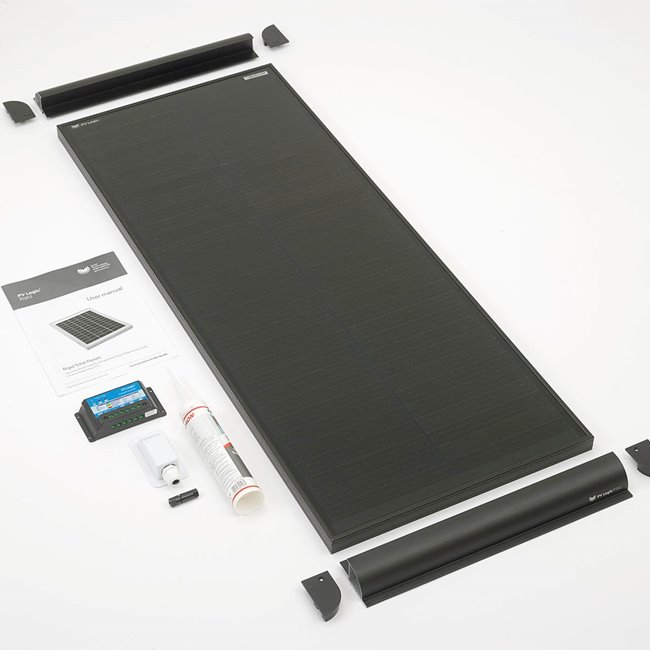
The live price is £305 including VAT. That is higher than the headline prices of the three alternatives, so the case must rest on what arrives and how well it suits the job. Here the kit includes the narrow all-black 100W panel, white acrylonitrile butadiene styrene (ABS) corner mounts, a dual-battery 10A pulse width modulation (PWM) controller, four metres of solar cable, connectors, a cable-entry gland, an inline fuse and bonding agent. I am not left discovering halfway through the installation that the panel mount and adhesive were only pictured beside the kit.
A compact 100W panel for a permanent marine fit
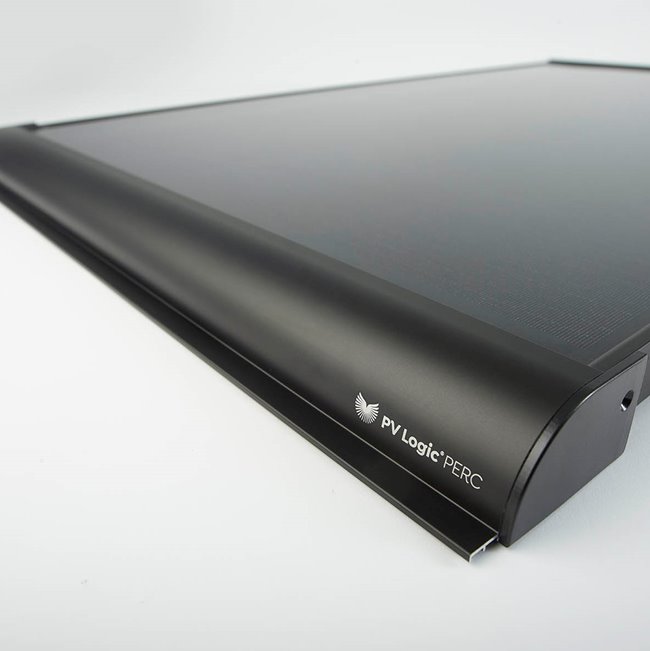
The panel measures 1,150mm by 460mm by 35mm and weighs 6.9kg. That 460mm width is useful on a wheelhouse roof, cabin top or motorhome where vents, rails and hatches have already claimed the broad clear areas. Solar Technology uses a mono high-density shingled-cell layout, which places the cells close together and avoids the bright grid of conventional front busbars. The practical benefit is fitting 100W into a long, narrow footprint.
Published electrical figures are 18.8V at maximum power, 5.32A at maximum power, 22.2V open circuit and 5.64A short-circuit current. Solar Technology also quotes up to 31.92 amp-hours per day using six peak-sun hours in its calculation. I treat that as a common comparison figure, not a forecast for a grey Irish Tuesday. Real yield changes with season, latitude, shade, panel temperature, battery state and controller losses. What matters is that the rating gives me a credible base for an energy audit before deciding whether one 100W panel covers the intended loads.
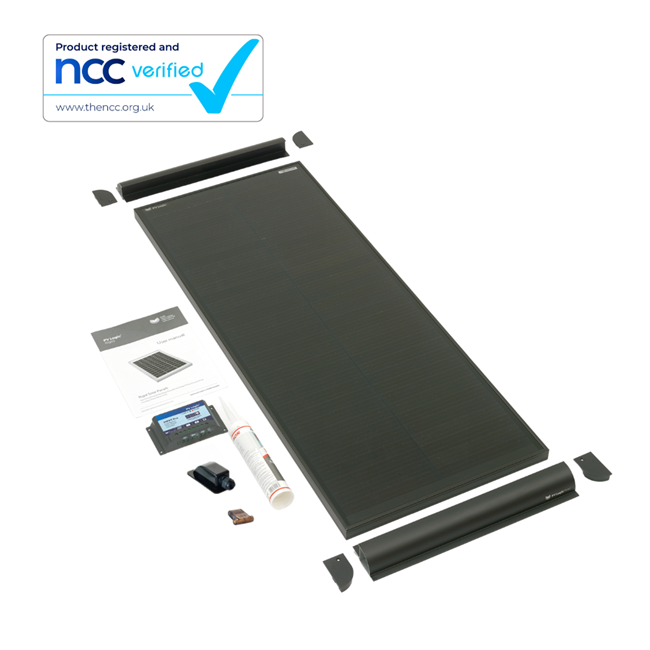
The module carries an ingress protection rating of IP67 and a ten-year module warranty. The National Caravan Council (NCC) verification listed by the manufacturer adds an independent check. None of that excuses careless placement. Even a thin shadow from a rail, aerial or boom can pull output down, so I would map the sun path and likely working arrangement of the boat before bonding anything permanently.
Controller, two batteries and the installation kit
The included 10A controller can recognise 12V or 24V systems automatically and charge two battery banks. That matters on a boat with separate service and engine-start batteries, where maintaining both is more useful than feeding one bank while the other waits. Protection functions cover reverse current, overcharge, open circuit, electrical surge and deep discharge. Its display and battery-priority settings make the source easier to manage.
I would still begin with the controller manual and a proper wiring plan. The controller belongs close enough to the batteries for sensible voltage drop, in a suitable ventilated and protected position, while the panel cable needs support, chafe protection and a watertight entry. Cable size and fuse placement should be confirmed for the final run and the boat’s electrical arrangement. A competent marine electrician should deal with any uncertainty, especially where existing charging sources, battery types or isolation arrangements interact.
The ABS corner mounts are intended to bond to a roof or deck, avoiding holes through the mounting surface. That reduces potential leak paths and leaves airflow beneath the panel, but preparation is decisive. I would check substrate compatibility, clean and key the area exactly as the adhesive instructions require, respect cure times and avoid assuming that yesterday’s dry-looking deck is ready for bonding. Sealant has a remarkable sense of timing when rain is coming; the cure schedule deserves a calm weather window.
The gland, connectors, cable, fuse and bonding agent make the package easier to cost honestly. Four metres of cable is a useful included length, though I would measure the actual route rather than a straight line across the cabin. Cables have to follow protected paths, and boats contain corners that seem to multiply after the tape measure is put away. If the route is longer, the extension and conductor size should be chosen on calculated voltage drop, not simply matched by colour.
Solar Technology 100W Rigid MHD Kit vs Sunshine Solar 100W Kit vs SunStore 100W Vehicle Kit Duo vs Photonic Universe 100W Folding Kit
| Product | Current price | Panel format and size | Weight | Controller and banks | Mounting and cable | Installation items | Warranty and marine detail |
|---|---|---|---|---|---|---|---|
| Solar Technology 100W Rigid MHD ABS kit | £305 | Rigid mono high-density; 1,150 × 460 × 35mm | 6.9kg | 10A PWM; automatic 12V/24V; two battery banks | White ABS bonded corners; 4m solar cable | Connectors, gland, inline fuse and bonding agent included | 10-year module warranty; IP67 panel; NCC verified |
| Sunshine Solar 100W kit | £125 | Rigid shingled; 1,190 × 450 × 30mm | 5.7kg | 10A PWM; single- or dual-bank option | ABS mounts; 6m extension cable | Cable gland included; battery lead, fuse and adhesive listed as paid additions | 5-year manufacturing warranty; longer stated output cover |
| SunStore 100W Vehicle Kit Duo | From £207 | Rigid panel choices; widths from 510 to 670mm | Depends on chosen panel | 10A dual-battery controller | Mount choices; 5m solar cable | Bonding agent, gland, connectors, two fuse holders and fuses included | Configurable vehicle kit; warranty depends on selected panel |
| Photonic Universe 100W folding kit | £230 | Two 50W folding sections; 510 × 690 × 60mm folded | 12kg | Waterproof 10A PWM; one battery bank | Freestanding folding frame; 5m lead | Storage case, plug, fuse and battery clips included | Portable IP67 controller; one-year workmanship warranty |
For a permanent boat or motorhome installation, the Solar Technology package is the strongest overall purchase. The £125 Sunshine headline is attractive, but its current listing puts the battery-to-controller lead, fuse and adhesive among paid additions; the Solar Technology box already covers those less glamorous pieces and adds a ten-year module warranty, IP67 panel specification and a compact 460mm-wide format. SunStore’s from-£207 Duo is a credible complete kit, yet its price, dimensions and warranty change with the selected panel and mounting option. The £230 Photonic Universe package is designed around portable deployment, weighs 12kg and charges one bank, so its case and folding stand are solving a different problem. I would pay the higher Solar Technology price because it gives me the narrow permanent panel, bonded marine-friendly mounting and managed two-bank charging as one clearly specified installation.
Output, maintenance and long-term value
Once fitted, the panel should still be treated as working equipment. Salt, bird dirt and harbour grime reduce the light reaching the cells, so I would rinse and clean it using the maker’s guidance, inspect the bonded mounts, check the cable supports and look for heat or corrosion at electrical connections. The controller display provides a useful routine check, but I would compare its behaviour with battery voltage and the expected conditions rather than chase a single daily number.
A 100W array can make a meaningful contribution to navigation electronics, pumps, lighting, refrigeration and battery maintenance when the loads have been measured honestly. It is not a substitute for an energy budget. I would list each load, estimate realistic hours, allow for conversion and charging losses, then compare that demand with conservative seasonal generation. If the plan later grows, Solar Technology lists related mounting choices and controller upgrades, including maximum power point tracking (MPPT) options, but this exact SKU is the ABS-mounted, 10A PWM package described here.
My conclusion follows the hardware. The price buys more than a panel: it buys a narrow, discreet module, permanent bonded mounting, two-bank charge control and the small installation parts that make the published design achievable. See the Solar Technology 100W Rigid MHD ABS and 10A PWM kit at Flood Marine and check the available roof or deck area against the full 1,150 × 460mm footprint.
About this review
I checked the live Flood Marine and Solar Technology listings alongside current Sunshine Solar, SunStore and Photonic Universe UK prices and specifications on 26 September 2026. My assessment is editorial and based on published information; it is not an instrumented performance, durability or sea test. Independent reviewer Neil Duddy wrote it; the article was not written by Flood Marine Services.
More detail