A hard cooler organised for small-boat days
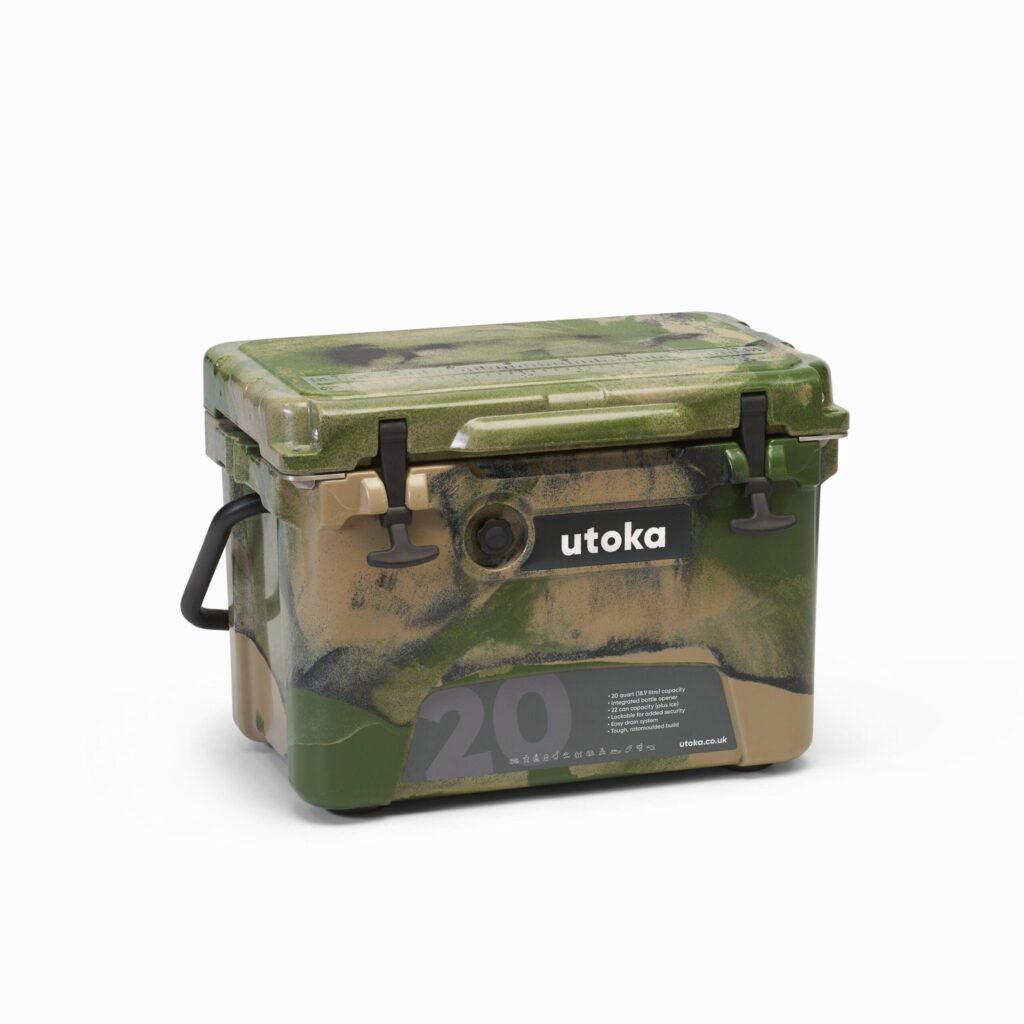
A hard cooler earns its place on a small boat when one box replaces several loose jobs. The Utoka 20 Camo holds 18 litres, or 20 quarts, and Utoka rates it for 22 cans. Yet the reason I would choose it is not capacity alone. At £237 including VAT, the standard package includes a chopping-board divider, dry-goods basket and cup holder, so drinks, food and the items that must stay out of meltwater can begin the day properly separated.
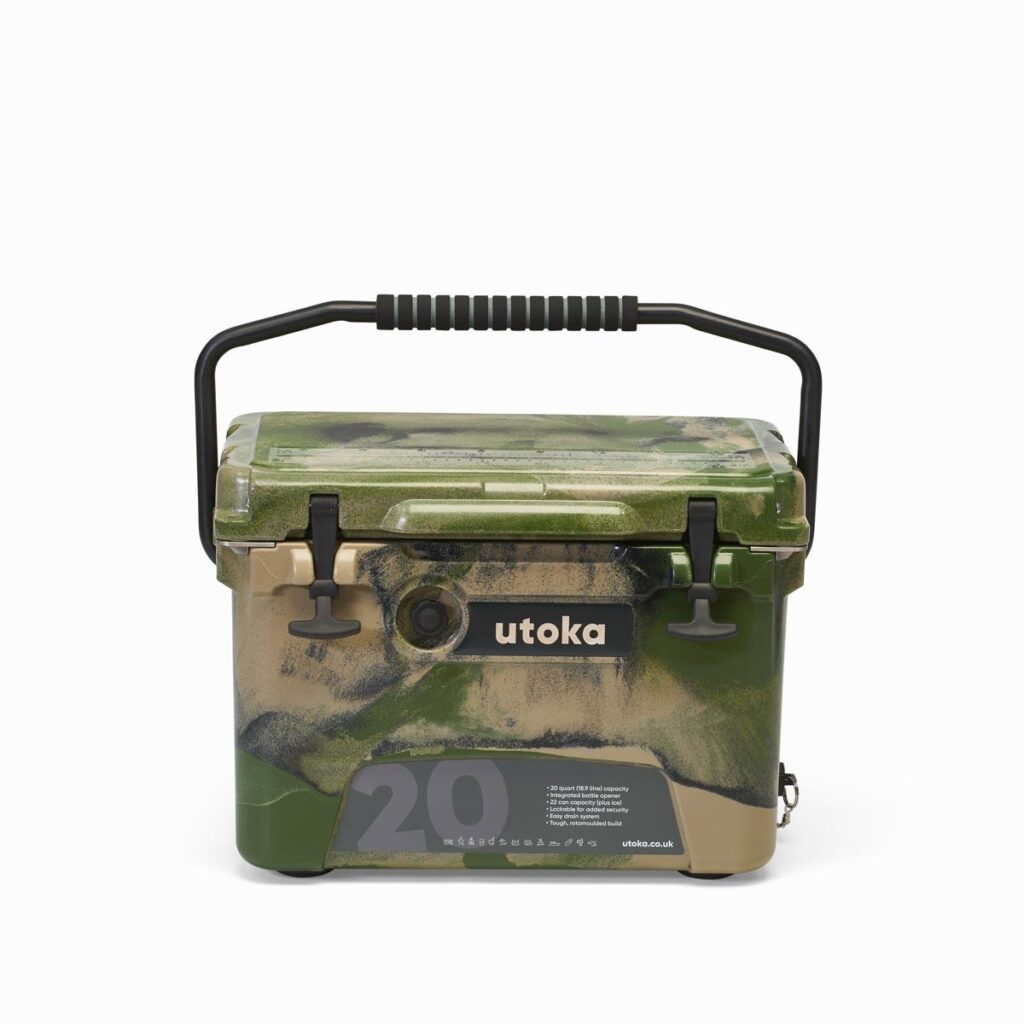
That organisation matters from the first launch. I can keep sandwiches above the ice, use the divider while preparing bait or lunch, and give a mug or bottle a fixed place instead of balancing it on a tube or thwart. The rotomoulded body has non-slip feet, heavy rubber closures, a lockable lid, integrated stainless-steel bottle opener and drain. Each part addresses a familiar little nuisance, and taken together they make the box feel designed for work aboard rather than adapted from a picnic.
Useful size before the ice goes in
The external dimensions are 54 by 34 by 36 centimetres, with an internal space of 37 by 25 by 21 centimetres. Empty weight is 7 kilograms. I find that a sensible middle ground for a fishing day: large enough to carry food and drinks, yet short enough to sit on paddleboards, canoes, kayaks and compact boat decks without becoming the main piece of furniture.
Utoka builds the shell from rotomoulded linear low-density polyethylene around polyurethane foam insulation and claims cooling for up to five days. I would treat any duration claim as dependent on ice ratio, starting temperature, shade and how often the lid is opened. The construction still gives me a solid, repeatable basis for longer days, and the continuous moulded body is well suited to being lifted, tied down and cleaned.
Utoka 20 Camo vs YETI Roadie 24 2.0 vs Dometic Recon Hardside 16L vs Ninja FrostVault 30QT Wheeled
| Hard cooler | Current price inc VAT | Difference | Capacity | Size or weight | Published cold claim | Included organisation | Handling and boat use | Drain, lock and opener |
|---|---|---|---|---|---|---|---|---|
| Utoka 20 Camo | £237 | Reviewed model | 18 L / 20 qt / 22 cans | 54 × 34 × 36 cm; 7 kg | Up to 5 days | Chopping-board divider, dry-goods basket and cup holder | Carry handle, non-slip feet, seat use and rod-holder insert compatibility | Drain plug, lockable lid and stainless-steel bottle opener |
| YETI Roadie 24 2.0 | £225 | £12 less | 24 qt; 33 cans without ice | Published ice capacity 11.8 kg | No day claim on checked UK page | No basket or divider included; basket £25 extra | DoubleDuty strap and tie-down points; not recommended as a standing platform | BestDam drain plug and lockport; no opener published |
| Dometic Recon Hardside 16L | £230 | £7 less | 16 L / 18 cans | Up to 30% lighter than comparable coolers; exact weight not published | Two inches of insulation; no day claim on checked UK page | No basket, divider or cup holder included | Dual-opening removable lid, non-skid base and stackable shape | Drain, spigot caps, lock/tie-down points and bottle-opener latches |
| Ninja FrostVault 30QT Wheeled | £250 | £13 more | 28 L / 30 qt; 48 cans without ice | Wheeled format with telescopic handle | Up to 5 days | Separate dry-zone drawer; no chopping-board divider or cup holder included | Wheels and handle suit firm ground; larger footprint than the Utoka | Drain plug; no lock or opener published on checked listing |
I put the Utoka first because it is the only cooler here supplied with the chopping-board divider, dry basket and cup holder together, and it adds a lockable lid, opener, five-day claim and small-craft compatibility in a compact 7-kilogram box. The Roadie is £12 less, but its basket costs another £25 and it includes neither the Utoka divider nor cup holder. The Recon is £7 less, though it holds 16 litres and lacks those included organisers. The wheeled Ninja costs £13 more and brings a larger dry-zone format, but its 28-litre body is a bulkier answer on a small deck. For this job, the Utoka’s standard equipment and manageable footprint produce the strongest value.
The divider changes how the space works
A plain cavity encourages everything to settle together by midday. The Utoka’s divider gives the 18-litre interior structure, and because it also serves as a chopping board, it earns its volume twice. I can reserve one side for cans and ice, keep food grouped on the other, then lift the board when I need a clean preparation surface. The dry basket keeps smaller items above the cold water instead of asking a plastic bag to perform that task.
I would still pack by sequence: later food at the bottom, first drinks near the top, and enough ice or frozen blocks around pre-chilled contents. That reduces lid openings and makes the five-day insulation claim more achievable in practice. My point is not that accessories replace good packing; it is that the included pieces make good packing easier to repeat.
A seat and fishing companion
Utoka states that the lid can serve as a seat, which gives the box another useful role on a paddleboard or open boat. The moulded inserts can accept a cup holder and a fishing-rod holder, while the non-slip feet help the cooler stay planted. I would still secure it appropriately for the craft and conditions, but the product has clearly been considered in the context of canoes, kayaks and paddleboards rather than only a car boot.
The tough carry handle is important because 7 kilograms is only the starting weight. Twenty-two cans, food and ice quickly turn any cooler into a deliberate lift. I like a single rigid handle for the walk from vehicle to pontoon, then tie-down points and a stable base once aboard.
Closures, drain and daily cleaning
Heavy-duty rubber latches draw the lid down, and the lockable arrangement helps protect the contents when the box is left at a campsite or on a deck. At the end of the trip, the drain plug lets meltwater out without tipping the entire load. I would open it only where runoff is appropriate, rinse the interior with mild cleaner, clear the seal and leave the lid open until fully dry.
The stainless-steel bottle opener is mounted at the corner, where it is available without becoming another loose tool. None of these details is dramatic, but ownership is mostly made of repeated small actions. The Utoka handles those actions in a straightforward order: close, carry, secure, use, drain and clean.
Rotomoulded construction and long-term use
Rotomoulding creates a one-piece shell with rounded forms and substantial walls around the insulation. For marine use, that gives me a robust surface that can take regular handling and is simple to wash. The polyurethane foam supplies the thermal layer, while the rubber feet and closures are replaceable wear points I can inspect rather than hidden mechanisms.
I would check the lid seal, latch tension, handle pivots, drain plug and feet before the season, then store the cooler clean and dry. Camo is a practical fishing-box finish because marks from banks, vans and decks are less visually dominant.
Neil’s verdict
I recommend the Utoka 20 Camo for anglers, paddleboard users and small-boat owners who need one manageable box to carry cold contents, organise food and serve a second purpose aboard. Its 18-litre capacity, 7-kilogram empty weight and 54-centimetre length are easy figures to plan around, while the five-day claim and rotomoulded shell support trips beyond a quick afternoon.
At £237, my conclusion rests on what is supplied. The chopping-board divider, dry basket and cup holder would be extra purchases or absent features with the nearest alternatives, and Utoka adds the seat function, rod-holder compatibility, lock, drain and opener without moving to a wheeled 28-litre footprint. See the live Utoka 20 Camo listing at Flood Marine.
About this review
I used the live Flood Marine product page, Utoka’s official Utoka 20 specifications and current advertised UK listings from YETI, Dometic and Tesco for the Ninja FrostVault. My fact and advertised-price check is dated 23 September 2026. This editorial assessment is not an instrumented performance, durability or sea test. I am Neil Duddy, the independent reviewer, and this article was not written by Flood Marine Services.
More detail