Compact isolation with a removable control
A battery switch earns its place when the job is awkward: isolate the supply quickly, leave the boat knowing the circuit is properly off, and get back to work without fighting a handle buried behind a cable run. I like the BEP 701 because it treats those ordinary jobs as design requirements. It is a compact on/off master switch, not a selector dressed up with positions that are irrelevant to a single-bank installation.
At £46 including VAT, this is not the least expensive switch in the comparison. I would still put it first for a small commercial boat, fishing boat, tender or leisure craft that needs a tidy, protected installation. The useful difference is not one spectacular number. It is the way the removable knob, covered terminals, flexible mounting and properly stated electrical ratings work together. Battery-box arithmetic gets inventive once the lid is off; a switch that can adapt to the available space is worth having.
Why the BEP 701 works aboard
The published figures are strong for a switch measuring 69mm square and 75mm deep. BEP rates it at 275A continuously, 455A for five minutes and 1,250A for a ten-second engine-starting load, with a maximum system voltage of 48V direct current (DC). Two M10 studs accept substantial cable connections, and the manufacturer lists cable capacity up to 3/0, or 95mm². I read those numbers as a sensible match for the main isolation duty on many modest outboard and inboard installations, provided the cable, protection and whole circuit have been specified correctly.
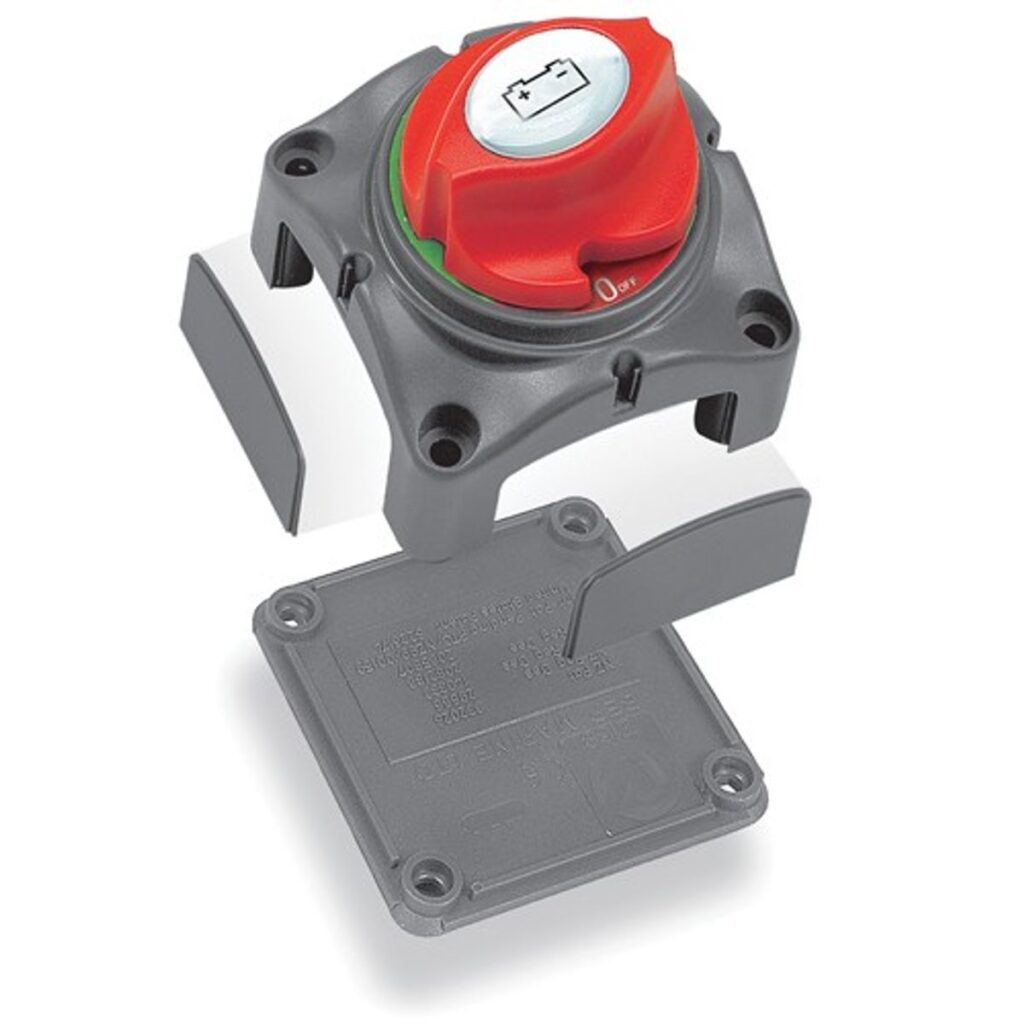
The red knob is more thoughtful than it first appears. It turns normally between on and off, then removes only when rotated a further 45 degrees anticlockwise beyond off. That gives me a simple physical check that the circuit has been isolated and lets the knob be taken away when access needs controlling. It also avoids a loose key sticking out during normal running. The position labels are interchangeable, so the finished panel can state its purpose clearly rather than relying on somebody remembering which red switch feeds what.
BEP’s Contour Locking System is the other practical advantage. Side plates can be removed for cable entry, the rear terminal cover keeps the live connections guarded, and the same unit can be surface mounted or recessed through a 52mm opening. I can bring heavy cable in from a workable direction instead of persuading it around a corner it never agreed to. A cable lug has a talent for arriving at the least cooperative angle.
Ignition protection and compliance with the relevant American Boat and Yacht Council (ABYC) battery-switch requirements matter on a petrol-powered boat or anywhere vapour control is part of the installation plan. They do not replace sound installation. I would have a competent marine electrician confirm cable size, overcurrent protection, location, terminal torque and circuit arrangement. The switch needs to remain accessible, dry enough for its stated installation, and protected from loose gear. The rear cover is valuable precisely because the current available from a battery can turn a dropped metal tool into a serious event.
Installation, use and ownership
For a surface installation, the 69mm footprint is easy to plan on a battery-box face, console panel or equipment board. For a recessed installation, the body sits back while the knob and marked bezel remain visible. I would dry-fit the cables before drilling, leave a service loop that does not strain the studs, crimp proper tinned lugs, and support the cable so engine vibration is not carried by the terminals. The last fastener always knows when the light is fading, so I prefer to mark every hole while access is still good.
In daily use, an on/off switch should be obvious. Clockwise is on, anticlockwise is off, and the removable-knob position comes after off rather than interrupting the normal movement. That is easier to explain to another skipper than a multi-position selector. It also gives a clear end-of-day routine: stop the engine according to its handbook, switch off appropriate loads, isolate the battery, and remove the knob if the operating procedure calls for it.
I also like the product-family logic. The 701 shares BEP’s modular contour format, so it can sit neatly with compatible distribution equipment instead of looking like an afterthought. A five-year manufacturer warranty adds useful backing. More important to me is the serviceability of a conventional manual switch: the state is visible, the heavy studs are accessible for inspection, and there is no electronic control layer between the operator and the isolation point.
BEP 701 vs Blue Sea 6006 vs Vetus BATSW250 vs Durite 0-605-26
| Product | Current price | Continuous rating | Published short rating | Maximum voltage | Mounting | Terminals and cable access | Control and protection |
|---|---|---|---|---|---|---|---|
| BEP 701 | £46 | 275A | 455A for 5 min; 1,250A for 10 sec | 48V DC | Surface or 52mm recess; 69mm square | Two M10 studs; removable side plates; rear cover | Knob removes beyond off; interchangeable labels; ignition protected |
| Blue Sea 6006 | £35 | 300A | 500A for 5 min; 900A for 30 sec | 48V DC | Surface, front-panel or rear-panel options | Two M10 studs; compact mini case | Fixed knob; ingress protection rating IP66; ignition protected |
| Vetus BATSW250 | £92 | 250A | 2,500A for 5 sec | Published for 12V/24V systems | Flange-mounted body | M10 connections; conventional rear access | Removable key in off; usable in positive or negative cable |
| Durite 0-605-26 | £88 | 250A at 24V | 2,500A for 5 sec | 24V published duty | Panel-mounted double-pole body | Four M10 main terminals; separate circuits | Fixed handle; double-pole isolation |
The Blue Sea 6006 has a higher continuous figure and a useful IP66 enclosure rating, but the BEP gives me the stronger overall installation package for this job: removable-knob control, modular side entry, a covered rear face, interchangeable identification and a higher stated ten-second start rating in a similarly compact footprint. Vetus publishes an impressive five-second figure, yet its £92 price and conventional keyed form make the £46 BEP the more rounded everyday choice. The £88 Durite is a sound double-pole specialist switch; four main terminals and a larger two-circuit task add cost and installation bulk when the requirement is straightforward single-pole battery isolation. I would buy the BEP because it combines the features I use every time with the ratings I need only at the hardest moment.
That balance also supports future ownership. A clearly labelled manual isolator helps fault-finding, winter lay-up and routine electrical work, while the removable side panels leave options if the battery layout changes. I would inspect the terminals periodically for movement or corrosion, keep the cover in place, and exercise the switch rather than leaving it untouched for a season. Those are ordinary maintenance habits, not special treatment.
My verdict is firm. The BEP 701 is the best overall purchase here for a compact single-circuit marine installation: properly rated, straightforward to operate, adaptable to fit and sensibly priced. See the BEP 701 Battery Switch 275A at Flood Marine and match it to the cable and protection plan for the boat.
About this review
I checked the live Flood Marine listing, BEP and Navico manufacturer material, and the current Blue Sea, Vetus and Durite UK retail listings on 26 September 2026. This is an editorial assessment based on published information rather than an instrumented performance, durability or sea test. Independent reviewer Ciaran Hughes wrote it; the article was not written by Flood Marine Services.