Twelve rollers for a cleaner small-boat recovery
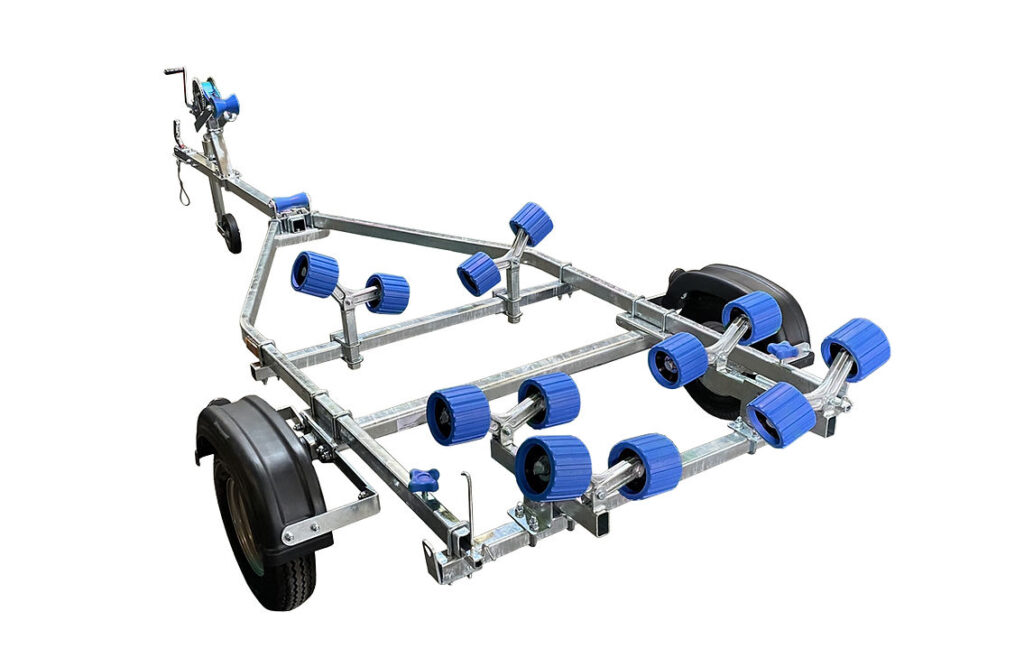
The awkward part of a recovery begins when the stern is still afloat, the bow has found the winch line and a side wind decides it has a vote. A crosswind has never read the recovery plan. I want the trailer to centre the hull, support it across sensible points and let one careful person finish the job without a wrestling match. The Extreme EXT400 Roller is built for that small-boat role, with 12 non-marking wobble rollers, a heavy-duty keel roller and an advertised Flood Marine price of £1,500 including VAT.
The figures set clear boundaries. Gross capacity is 400 kilograms, the trailer weighs 100 kilograms and carrying capacity is 300 kilograms. Extreme lists hard boats up to 11 feet, rigid inflatable boats (RIBs) up to 3.8 metres and dinghies up to 14 feet where overhang is acceptable. Overall size is 3.85 by 1.57 metres. It is an unbraked, fully galvanised chassis on 8-inch wheels, with waterproof sealed bearings, a 1,000 lb Knott winch, 48 mm jockey wheel and a 7-pin light board on extendable bars.
Extreme EXT400 Roller vs De Graaff SB600/2 vs De Graaff SB750/2 vs Admiral 400 kg T-Frame
| Small-boat trailer | Current price | Difference | Rated payload or capacity | Published boat fit | Hull support | Chassis and running gear | Winch | Included launch equipment |
|---|---|---|---|---|---|---|---|---|
| Extreme EXT400 Roller | £1,500 | Reviewed model | 300 kg carrying; 400 kg gross | Hard boats to 11 ft; RIBs to 3.8 m; dinghies to 14 ft with overhang | 12 non-marking wobble rollers plus heavy-duty keel roller | Galvanised adjustable U-bolt chassis; 8 in wheels; sealed bearings | Height-adjustable post; 1,000 lb Knott winch | 48 mm jockey wheel; 7-pin light board on extendable bars |
| De Graaff SB600/2 | £1,605 | £105 more | 400 kg published capacity | 10–14 ft / 3–4.5 m | 12 side rollers on swing beams; no centre keel rollers | Welded hot-dip galvanised chassis; 10 in wheels; adjustable/removable drawbar | Winch with strap | Further standard equipment not itemised on cited listing |
| De Graaff SB750/2 | £2,070 | £570 more | 500 kg published capacity | 12–16 ft / 3.7–4.9 m | 16 side rollers on swing beams; no centre keel rollers | Welded hot-dip galvanised chassis; 10 in wheels; adjustable/removable drawbar | Winch with strap | A larger unbraked chassis for longer boats |
| Admiral 400 kg T-Frame | £1,545 | £45 more; £110 more with roller upgrade | 400 kg carrying; 500 kg stated weight capacity | Up to 14 ft / 4.26 m | Two rubber chocks and three keel rollers standard; wobble rollers £65 extra | Galvanised adjustable chassis; 10 in wheels | Winch and V-bow snubber | Jockey wheel; light board and adjustable arms; tie-down loops |
For the stated job, I make the EXT400 the strongest overall purchase. The De Graaff SB600/2 has a 400-kilogram capacity and 12 swing-beam rollers but costs £105 more; the larger SB750/2 adds capacity and four rollers for £570 more. The £1,545 Admiral carries 400 kilograms, yet its base form uses two chocks and three keel rollers; the £65 wobble-roller option takes comparable spend to £1,610. Extreme puts 12 wobble rollers, a keel roller, sealed bearings, the 1,000 lb Knott winch, jockey wheel and extendable light board together for £1,500.
Support comes before convenience
The 12 wobble rollers sit in paired banks that can be positioned under suitable parts of the hull. They share load and guide the boat, while the keel roller supports the centreline where the hull design permits. I would set every bank to the actual boat. The transom and other strong areas need deliberate support, and fittings, strakes and transducers need clearance throughout recovery.
Non-marking rollers are welcome on a clean gelcoat hull, but correct contact matters more than colour. I look for even load, free rotation and no single roller trying to carry the afternoon by itself. With a RIB, tube clearance and hull shape need equal attention. Five minutes of adjustment at home beats twenty at the slip, where every passing car somehow sounds impatient.
Payload needs real arithmetic
The useful number is the 300-kilogram carrying capacity, not the 400-kilogram gross figure alone. I would total the boat, outboard, battery, fuel, anchor, tank, safety kit and everything left aboard. Trailer arithmetic has a habit of arriving just after the boat is loaded. A sensible margin keeps each future accessory from becoming a fresh crisis.
Extreme lists hard boats to 11 feet, dinghies to 14 feet with overhang and RIBs to 3.8 metres. Those are fit guides, not permission to exceed payload or accept poor balance. I would confirm the hull builder’s support requirements and check final nose weight against the actual tow-vehicle and coupling limits.
Adjustment in the right order
I start with the axle and frame relationship, establish the bow stop and winch-post position, then set the roller banks. U-bolt construction permits adjustment without cutting or welding. The strap should pull the bow cleanly into its stop rather than lift or drag it. I would tighten to the specified values and repeat the load check after settling.
The 1,000 lb Knott winch is appropriately specified for controlled recovery, with the usual discipline around strap condition, hook security and keeping hands clear. I also like that the 48 mm jockey wheel is included. It supports orderly positioning on firm ground, but it is not an excuse to let a loaded trailer wander on a slope. Chocks and a planned sequence still do the quiet work.
Towing and launch setup
At 3.85 by 1.57 metres, the EXT400 stays compact. Its 8-inch wheels keep the chassis low, while extendable bars let the light-board position follow the setup. I would check the 7-pin connection, board visibility, number plate and cable route before every road move.
Before towing, I check coupling engagement, secondary connection, tyre condition and pressure, wheel security, lights, tie-downs, winch strap and a separate stern restraint. Boat length, load position and tow-vehicle limits all affect stability. The unbraked rating makes the weight calculation especially important; the legal gross limit and the vehicle’s plated limits remain the ceiling, even when the road home is short.
Maintenance after salt water
Waterproof sealed bearings reduce intrusion risk, but hubs, tyres and fasteners still need inspection. After salt use I would rinse the roller spindles, winch, coupling, jockey assembly, light-board hardware and bracket pockets. Keeping drain paths clear and treating accidental damage helps the galvanising protect the steel.
Rollers should turn freely without excessive play, straps should lie flat and electrical plugs should stay clean and dry. I would recheck U-bolts and adjustment points after the first loaded journeys because a newly set trailer can bed in. A simple written tyre and bearing schedule is worth having when the trailer spends more time parked than moving.
Ryan’s verdict
I recommend the EXT400 Roller for a properly weighed small hard boat, dinghy or RIB that fits the published dimensions and stays within the 300-kilogram payload. It gives the owner the useful pieces at once: 12 adjustable wobble rollers, keel support, sealed bearings, a proper Knott winch, jockey wheel and extendable light board.
My figures add up plainly. At £1,500, the Extreme supplies the best-balanced small-boat recovery setup here without charging for capacity or chassis length the reviewed job cannot use. Set it to the hull, confirm the loaded weights and keep the running gear inspected. See the Extreme EXT400 Roller at Flood Marine.
About this review
I based this editorial assessment on the live Flood Marine product page, Extreme Trailers’ current specification, De Graaff Trailers’ live model and price list, and Trailer Marine Supplies’ advertised Admiral specification and price. I checked prices on 20 September 2026. The result is editorial, not an instrumented test of performance or durability and not a sea test. I wrote it independently as Ryan Kerr; Flood Marine Services did not write it.