Small enough to carry and built for years of tender work
A small tender engine has one job before it ever reaches the water: it has to be carried without turning the trip from the car into a weightlifting event. After that, it must start cleanly, steer in a cramped stern and push home without fuss. The Yamaha F2.5 gets those priorities in the right order. It is compact, properly finished and simple enough that the engine never becomes the main event.
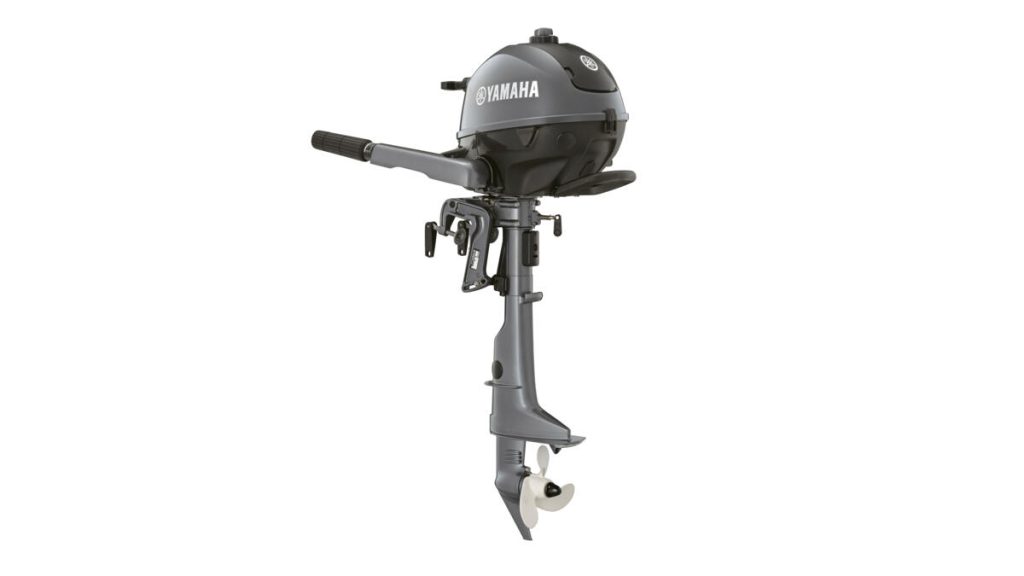
The listed price is £790 including VAT, with a propeller and internal fuel tank. Short- and long-shaft versions cover the usual tender transoms, weighing 17 and 18 kilograms respectively. I would describe it as a true portable rather than a small outboard that merely has a handle. There is a difference, usually discovered halfway down a wet pontoon.
What matters when the boat is only eight feet long
The 72 cubic-centimetre single-cylinder four-stroke is deliberately uncomplicated. Manual starting, tiller control and a self-contained fuel supply keep the installation tidy. There is no external tank hose to coil in the bottom of a little inflatable, and no battery taking up the space intended for feet or shopping. The engine can pivot through 360 degrees, so reverse is achieved by turning the leg. On a short tender, that gives excellent control and removes a gearbox function that would add weight and complexity.
The carry handle and compact cowling make storage sensible aboard a larger boat or at home. Yamaha also offers both shaft lengths rather than making the owner adapt the transom to the engine. That choice is worth getting right: correct immersion keeps the propeller working cleanly and avoids hanging unnecessary leg in the water. Once fitted, the little Yamaha feels neat and settled instead of improvised.
Yamaha F2.5 vs Suzuki DF2.5S vs Honda BF2.3 SHU vs Tohatsu MFS3.5C
| Portable outboard | Price including VAT | Published dry weight | Engine | Tender handling | Useful ownership details |
|---|---|---|---|---|---|
| Yamaha F2.5 | £790 | 17–18 kg | 72 cc; single-cylinder four-stroke | Full 360-degree pivot; forward gear with turn-to-reverse steering | Internal tank and propeller included; short- or long-shaft choice; established Yamaha service and resale demand |
| Suzuki DF2.5S | £715 | About 13.5 kg | 68 cc; single-cylinder four-stroke | Full-pivot steering; forward-neutral transmission | Very light lift; internal tank; lower-capacity block and simpler charging provision |
| Honda BF2.3 SHU | £864 | About 13.5 kg | 57 cc; single-cylinder air-cooled four-stroke | Centrifugal clutch; full-pivot steering | No raw-water cooling circuit; distinctive clutch operation; internal tank |
| Tohatsu MFS3.5C S | £899 | About 18.4 kg | 86 cc; single-cylinder four-stroke | Forward-neutral gearing; full-pivot steering | Extra rated power; internal tank; heavier than the Yamaha short shaft |
Advertised prices and manufacturer specifications checked 11 September 2026. Prices are shown as whole pounds; shaft choice and retailer package contents can alter the final figure.
There is more here than the lightest number
Suzuki and Honda both undercut the Yamaha on published weight, while the Suzuki also starts at a lower advertised price. Tohatsu brings another horsepower and the largest displacement in this group. Those are genuine differences, but a tender engine is handled, stored and resold as well as run. The Yamaha sits between the extremes: lighter than the Tohatsu, larger in capacity than the Honda, and supplied as a complete basic package with the propeller in the price.
The full-pivot steering is especially good in tight spaces. Honda uses a centrifugal clutch, which has its own following, while Suzuki and Tohatsu provide a forward-neutral arrangement. Yamaha’s turn-to-reverse approach is easy to understand and gives direct thrust in either direction. I prefer that directness on a tender because there is no delay while a clutch decides whether the engine is idling or driving.
A Yamaha argument that grows with use
Yamaha’s small four-strokes have a long record on yacht tenders, harbour runabouts and support boats. Plenty live a leisurely life, but plenty more are started repeatedly through a season and carried aboard after every trip. That sort of commercial and high-hour use is valuable evidence. It shows why sound corrosion protection, familiar service parts and a robust clamp bracket matter on an engine this small.
Clean Yamaha portables with a sensible service record attract a healthy used market. Buyers recognise the model, understand its controls and know where parts fit into the picture. The purchase price buys more than 2.5 horsepower. It buys an outboard people know, a parts route that is well established and a design that has earned trust through ordinary hard work.
Ciaran’s verdict
I like the F2.5 because it behaves like proper equipment in miniature. The internal tank keeps the tender clear, the 360-degree steering is genuinely useful, and 17 kilograms remains a realistic one-person lift. It has enough engine capacity to feel unstrained at displacement speed, yet it stays compact enough to live in a locker or vehicle between outings.
The lighter rivals deserve their weight advantage and the Tohatsu offers more rated power, but the Yamaha is the most rounded tender engine here. It combines manageable weight, straightforward control, a complete basic package, a proven working record and strong recognition when resale day comes. That is why I would carry the Yamaha down the pontoon. I might still complain about the distance, but not the engine. View the Yamaha F2.5 product page.
About this review
I based this review on the product and manufacturer information listed in the sources, together with advertised UK prices checked on 11 September 2026. It is an editorial assessment, not an instrumented performance, durability or sea test. The words and opinions are Ciaran Hughes’s, and the article was not written by Flood Marine Services.