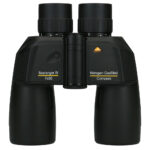
Digital bearings without leaving the view

At the helm in a broken swell, the useful number is the one I can read without lowering the binoculars. A buoy bearing, a headland or the direction of another vessel can change while I move between a compass and a separate pair of glasses. The Bynolyt SeaRanger IV 7×50 puts a digital heading and bearing in the view, and that practical link between seeing and measuring is what makes this £409 marine binocular different.
I like the familiar 7×50 format for a moving boat. Seven-times magnification gives useful reach without magnifying every shake of my hands, while the 50-millimetre objectives gather the light that matters near dusk, beneath cloud or against a dark shoreline. Bynolyt publishes a 7.1-millimetre exit pupil, a wide 131-metre field at 1,000 metres and 23 millimetres of eye relief. Put plainly, I get a broad picture and comfortable viewing rather than a narrow tunnel that makes a target awkward to reacquire.
Digital information that earns its place
The SeaRanger’s compass displays heading and bearing in one-degree steps, with stated accuracy of plus or minus three degrees. Its liquid-crystal display (LCD) also divides the horizon into eight compass zones. I can keep both eyes on the object, press for a bearing and read a number that is easy to pass to somebody else or note in a log. That is tidier than estimating between analogue graduations, particularly when the deck is moving and the light is poor.
Bynolyt also includes an inclinometer. The published operating range covers forward and reverse tilt to 60 degrees and sideways tilt to 45 degrees. On a sailing boat, I can use the heel reading as immediate context rather than treating it as a parlour trick. On a motor boat it helps me describe the angle of a sighting or understand why an observation feels less settled. The value is not that the binocular replaces the boat’s instruments; it is that useful orientation stays beside the image I am already studying.
The optics are fully multi-coated and the outer surfaces receive a hydrophobic treatment. Spray is still spray, and I would look after any optical instrument, but a water-repelling surface is a sensible marine detail when droplets otherwise break up contrast. BAK-4 prisms, individual eyepiece focusing and nitrogen filling complete a specification built for watchkeeping rather than occasional sightseeing. The ten-metre close-focus figure is useful around a harbour, and the individual focus arrangement suits a pair that may be set once for each eye and then lifted quickly.
Handling, protection and life aboard
At 1,630 grams, this is a substantial binocular. I would use the supplied flotation neck strap and give it a secure home at the helm rather than leave it wandering across a console. The weight brings the compass electronics, large prisms and protected body together, and in my hands it can also steady the view when I brace my elbows. The practical answer is good storage and a proper strap, not pretending that a serious 7×50 compass binocular should behave like a pocket glass.
The waterproof, nitrogen-filled body is the right foundation for repeated damp use. Nitrogen helps prevent internal fogging when temperatures shift, while the floating strap gives another layer of sense around the cockpit. I would still rinse salt from the exterior with fresh water, let the body dry before closing it into a case and clean the lenses with care. Reliability at sea is helped by routine, and optical coatings last better when they are treated as precision surfaces.
I also see a sound ownership case here. A compass binocular is shared equipment: family crew can identify a mark, a skipper can call a bearing, and a commercial operator can make a quick observation without asking somebody to read a second instrument. The digital result is especially easy to communicate. Bynolyt’s controls need a familiarisation session alongside the manual, but once I know the display and calibration routine, the information arrives in a calm, repeatable form.
Bynolyt SeaRanger IV 7×50 vs Steiner Navigator 7x50c vs Bushnell Marine 7×50 Compass vs Plastimo Topomarine Rescue 7×50 Compass
| Model | Current UK price | Price difference vs reviewed product | Compass | Tilt information | Optical view | Marine protection | Weight and included kit |
|---|---|---|---|---|---|---|---|
| Bynolyt SeaRanger IV 7×50 Digital Compass | £409 | — | Digital heading and bearing; ±3° accuracy; 1° steps; eight-zone display | Inclinometer; reads forward/reverse to 60° and sideways to 45° | 7×50; 131 m at 1,000 m; 10 m close focus; 23 mm eye relief | Waterproof; nitrogen filled; hydrophobic fully multi-coated optics | 1,630 g; flotation neck strap included |
| Steiner Navigator 7x50c | £499 | £90 more | Analogue liquid-damped, illuminated HD-stabilised compass | No inclinometer published | 7×50; 128 m at 1,000 m; 20 m close focus; 20.2 mm eye relief | Waterproof to 5 m; nitrogen filled | 1,115 g; strap, case and covers included |
| Bushnell Marine 7×50 Compass | £250 | £159 less | Illuminated analogue liquid-filled compass and rangefinding scale | No inclinometer published | 7×50; 117 m at 1,000 m; 10.6 m close focus; 18 mm eye relief | Waterproof, nitrogen purged and designed to float | Approx. 1,049 g; neck strap and case included |
| Plastimo Topomarine Rescue 7×50 Compass | £147 | £262 less | Battery-lit analogue compass; specified for 40–60° North | No inclinometer published | 7×50; individual eyepiece focusing; field and eye relief not published | Waterproof and designed to float | 900 g; case, neck strap and cloth included |
The Steiner costs £90 more and is 515 grams lighter, with waterproofing stated to five metres and a ten-year warranty, but its liquid-damped compass remains analogue and it publishes no inclinometer. The Bushnell is £159 less and combines a compass with a rangefinding scale, yet its field is 14 metres narrower at 1,000 metres and its eye relief is five millimetres shorter. The Plastimo is £262 less and light at 900 grams, though its checked specification limits the compass to an analogue, illuminated display and a stated 40–60-degree North operating band. I find the Bynolyt the strongest overall purchase because it is the only one of these four to combine a numeric bearing, one-degree readout, eight-zone display and tilt information, while also offering the widest published field and longest eye relief.
My verdict
I would choose the SeaRanger IV for a helm where binoculars are working instruments, not cupboard ornaments. Its price buys information that I can use immediately: a clear heading, a precise bearing and a heel or tilt reading without breaking visual contact. The hydrophobic coatings, nitrogen-filled waterproof body, broad field and generous eye relief support that electronic advantage with proper marine optics.
For passage work, harbour approaches, race support or repeated high-hour use, that integration saves small bits of uncertainty every time the binocular comes up. Those are the details I value after the novelty has passed. The SeaRanger is heavier than its rivals, but it returns more navigational context in the same view and undercuts the closest premium comparison. See the exact Bynolyt SeaRanger IV 7×50 Digital Compass model at Flood Marine.
About this review
Product specifications were checked against the live Flood Marine listing, official Bynolyt material and the named official or current UK competitor sources on 27 September 2026. This is an editorial assessment, not an instrumented performance, durability or sea test. The independent reviewer is Erin McKee, and the article was not written by Flood Marine Services.