Twenty-four rollers where the hull needs them

Recovery is when a trailer tells the truth. The boat is wet, the wind has found the worst angle and somebody’s sleeve is already in the water. At that point, a long chassis and plenty of properly adjusted rollers are not brochure decoration. They decide whether the hull centres itself or needs persuaded by hand.
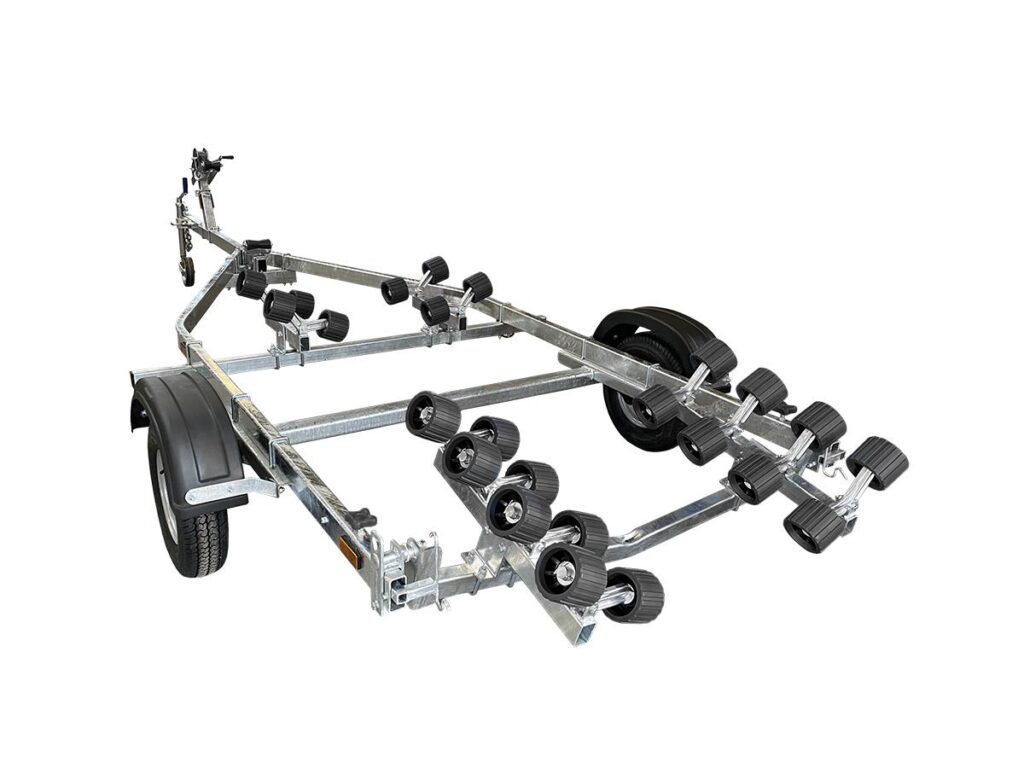
At £2,520 including VAT, the Extreme EXT750 Super Roller is an unbraked 750-kilogram gross trailer with 580 kilograms available for the boat and its carried equipment. The chassis is 5.24 metres long and two metres wide, with 24 non-marking wobble rollers, adjustable keel support and a Dutton-Lainson winch. I see it as a recovery system first and a road chassis second, although it has to do both jobs properly.
Twenty-four contact points change the recovery
Wobble rollers turn and settle against the hull as the boat comes forward. With 24 of them, the Super Roller spreads support along more of the underwater shape and gives the bow repeated guidance towards the centreline. That is especially useful on a shallow slip where the trailer cannot simply disappear beneath the boat.
Adjustment remains the important word. More rollers do not rescue a careless setup. Their height and angle need to follow the hull, the keel support has to share weight correctly and the transom must finish where the chassis can carry it. Once that is done, however, 24 contacts give far more scope to support a longer hull than a twelve-roller frame. Trailer arithmetic is rarely thrilling, but it is considerably nicer than trailer swimming.
The published fit reaches hard boats to 16 feet and rigid inflatable boats to 5.3 metres, subject to the 580-kilogram payload. That extra chassis length is the main difference from many EXT750 alternatives. A shorter trailer can have a larger payload on paper and still be the wrong shape for the boat. Weight comes first, then length, bow-eye position, transom support and nose weight all have to agree.
The hardware around the rollers
Extreme uses waterproof sealed bearings, 10-inch wheels and a 42-millimetre jockey wheel with a cast clamp. The height-adjustable winch post lets the bow stop meet the boat rather than dragging the boat towards a fixed guess. The extendable lighting board can be set behind the hull and pulled back in for storage.
The winch has useful authority for a loaded recovery. I still want the trailer deep enough and the rollers free enough that it is guiding rather than hauling a boat over badly placed supports. A strong winch is not permission to make the rest of the setup wrong; it is part of a system that should already be working with the hull.
Payload is the boat as it travels
The 580-kilogram figure has to include the hull, outboard, fuel, battery, anchor, electronics and loose equipment left aboard. A 400-kilogram bare boat can pass the advert and fail the real calculation very quickly. I work from the finished travelling load because the axle has no interest in what the empty brochure said.
The trailer itself weighs about 170 kilograms, bringing the gross figure to 750. That leaves a clear, usable number and keeps the package within the normal unbraked class when correctly loaded. The trade is that the long, roller-heavy chassis gives away some payload beside a lighter 750-kilogram trailer. It earns that mass back through hull support and fit for a longer boat.
Extreme EXT750 Super Roller vs Extreme Maxi Roller vs SBS R2/750EL vs De Graaff SB750/2 ADJ
| 750 kg trailer | Price including VAT | Gross and payload | Hull support | Published fit | Recovery equipment |
|---|---|---|---|---|---|
| Extreme EXT750 Super Roller | £2,520 | 750 / 580 kg | 24 wobble rollers plus adjustable keel support | 5.24 × 2.00 m; hard boats to 16 ft / RIBs to 5.3 m | Dutton-Lainson winch; sealed bearings; extendable light board |
| Extreme EXT750 Maxi Roller | £1,525 | 750 / 605 kg | 16 wobble rollers plus keel rollers | 4.75 × 1.57 m; hard boats to 14 ft / RIBs to 5 m | 1,000 lb winch; sealed bearings; extendable light board |
| SBS R2/750EL | £1,999 | 750 / 570 kg | 12 wobble rollers | 4 m bow-eye-to-transom | Easy-loader layout; galvanised frame; 10-inch wheels |
| De Graaff SB750/2 ADJ | £1,837 | 750 / 600 kg | Adjustable swing-beam multi-roller system | Set against hull and bow-eye dimensions | Adjustable winch post; galvanised unbraked single axle |
Advertised prices and published specifications checked 10 September 2026. Payload means the complete travelling boat and equipment, not the bare hull alone.
Where the longer chassis pays off
The Maxi Roller carries 25 kilograms more and shares the Extreme approach, but it has eight fewer wobble rollers, a chassis almost half a metre shorter and a smaller winch. De Graaff publishes a useful 600-kilogram payload and an adjustable swing-beam system, yet the compared specification does not match the Super Roller’s stated 24 contact points or its clear 5.3-metre rigid-inflatable-boat fit.
I see SBS as the weakest alternative in this group. Its 570-kilogram payload is lower than the Super Roller’s, and its 12 wobble rollers provide half the published contact points. The stated four-metre bow-eye-to-transom fit also places it well short of the longer Extreme chassis. The SBS price is lower, but there is no extra payload, roller count or published hull length to make it the stronger trailer.
The Super Roller therefore has a clear reason for being here. It is for a longer boat that fits inside a 580-kilogram payload and benefits from dense, adjustable roller support. The price is paying for chassis length, 24 rollers and stronger recovery hardware. Those features remain useful every time the boat comes home, not just on the first awkward slip.
What the figures add up to
I would choose the EXT750 Super Roller when the boat needs the long chassis and full roller bed. It guides the hull over 24 contact points, supports boats beyond the usual 14-foot trailer class and gives the winch, keel support and light board enough adjustment to make the finished rig tidy.
The sums still matter: 580 kilograms is the ceiling for the travelling boat. Inside that figure, the Super Roller is the most complete recovery trailer in this comparison. It turns the difficult part of the day into a repeatable job, which is as close as a trailer gets to good manners. View the Extreme EXT750 Super Roller product page.
About this review
Prices and specifications are based on manufacturer information and live advertised UK listings checked on 10 September 2026. This is an editorial assessment rather than a towing, immersion or recovery test. The article was written by Ryan Kerr and was not written by Flood Marine Services.