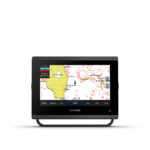
A seven-inch screen that can run a much bigger helm

A seven-inch plotter is often asked to replace a collection of smaller gauges while fitting into the only clear patch of dashboard. That is where the Garmin GPSMAP 723 makes sense. The screen is compact, but the connections behind it allow engine data, charts, radar, cameras, audio, instruments and compatible sonar to meet in one place.
The chartplotter-only unit costs £924 including VAT. It comes with a bail mount, flush-mount parts, protective cover, power cable, NMEA 2000 T-piece and two-metre drop cable. Sonar is brought in from compatible network hardware, so the 723 can sit at the centre of a planned Garmin system instead of limiting the helm to one built-in sounder.
The screen uses its small footprint well
Garmin says the 723 has 60 per cent more pixels and nearly twice the processing power of the previous seven-inch GPSMAP generation. The edge-to-edge glass and slim casing help it fit a crowded console, while improved sunlight readability keeps chart detail visible from an angle. Menus respond quickly, which matters when changing scale or moving from chart to radar near a harbour entrance.
Seven inches still rewards sensible page design. I would keep the main navigation view uncluttered and use saved combinations for engine data, instruments or camera feeds. SmartMode can recall the relevant page across a compatible station. That is much quicker than rebuilding a split screen while the boat is moving.
The connections are the real reason to buy it
Garmin Marine Network shares charts, radar, user data and IP camera video among compatible displays. National Marine Electronics Association (NMEA) 2000 and NMEA 0183 cover instruments, automatic identification system data, autopilots, radios and other equipment. J1939 support can bring compatible engine information—including selected Yamaha installations—onto the helm, while OneHelm can control supported third-party systems.
Built-in Wi-Fi connects to ActiveCaptain for chart management, software updates, route planning and notifications. ANT supports compatible wireless sensors and controls. The result is a small display that does not become a dead end as the boat gains equipment. I value that more than a long list of isolated apps. It also means a future radar or second display can join the same system without turning the dashboard into a fresh wiring project. At the helm, that continuity matters: the pages and controls remain familiar as the installation grows. That is a practical advantage, not a line for the box.
Garmin GPSMAP 723 vs Lowrance Elite FS 7 vs Simrad NSX 3007 vs B&G Zeus S 7
| Seven-inch display | Price including VAT | Display and interface | Sonar route | Boat networking | Strongest system fit |
|---|---|---|---|---|---|
| Garmin GPSMAP 723 | £924 | High-resolution seven-inch touchscreen; slim edge-to-edge glass | No built-in sonar; compatible network sonar and Panoptix support with added hardware | Garmin Marine Network; NMEA 2000 and 0183; Wi-Fi; ANT; J1939; OneHelm | Connected Garmin helm, compact retrofit, engine data and shared radar or camera use |
| Lowrance Elite FS 7 | £740 | High-resolution seven-inch multi-touch display | Active Imaging and ActiveTarget ready; transducers sold separately | Ethernet; National Marine Electronics Association 2000; integrated wireless | Fishing-led sonar expansion and C-MAP or Navionics chart choice |
| Simrad NSX 3007 | £945 | Seven-inch SolarMAX IPS touchscreen; NEON interface | Built-in sonar support; transducer by package | Ethernet, NMEA 2000, Wi-Fi and broad Simrad integration | C-MAP, Simrad radar and Mercury-centred installations |
| B&G Zeus S 7 | £1,025 | Seven-inch sailing-focused touchscreen | Sonar support by system and transducer | NMEA 2000, Ethernet and Wi-Fi | Sailing data, laylines and B&G instrument ecosystems |
Advertised prices and manufacturer specifications checked 11 September 2026. Charts, sonar modules, transducers, radar and network cables vary by package and are not assumed to be included.
One table, four quite different helms
Lowrance costs less and concentrates on fishfinding, with Active Imaging and ActiveTarget expansion available when the matching hardware is added. Simrad’s NSX also leans towards sonar and is particularly convincing in a C-MAP, Simrad radar or Mercury system. B&G takes the sailing route, putting laylines and wind-led information at the centre.
I would pick the Garmin when the priority is a compact chart-first display inside a broad connected system. Garmin Marine Network, both National Marine Electronics Association standards, J1939, OneHelm, Wi-Fi and ANT give it the widest mix in this comparison. Owners adding radar, cameras, instruments or compatible Yamaha engine data gain much more than the seven-inch diagonal suggests. The cheaper Lowrance is appealing for a fishing-led setup; the 723 is the stronger all-round command screen.
Erin’s verdict
I would choose the GPSMAP 723 for a smaller helm that needs clean navigation now and room to expand later. The display is sharp, the interface is quick and the supplied mounting and National Marine Electronics Association 2000 parts reduce the small surprises that appear during installation. Its lack of internal sonar is clear rather than hidden: compatible network sonar can be added when the boat’s job calls for it.
Lowrance, Simrad and B&G each make a clear specialist case. For a new all-round installation, or one built around Garmin and compatible Yamaha data, the 723 has the most convincing network foundation at this size. It keeps the everyday chart simple while leaving radar, cameras, instruments and sonar open for later. View the Garmin GPSMAP 723.
On an ordinary passage, I would set one clean chart page, one docking page and one engine-and-instruments page, then leave them alone until they are needed. The 723 is quick enough to move between those jobs without the pause that makes a skipper tap twice and end up somewhere else. Its value is not that every function is visible at once. It is that the right information can be reached in a familiar way while the screen remains small enough for a crowded console.
About this review
I based this review on the product and manufacturer information listed in the sources, together with advertised UK prices checked on 11 September 2026. It is an editorial assessment, not an instrumented performance, durability or sea test. The words and opinions are Erin McKee’s, and the article was not written by Flood Marine Services.