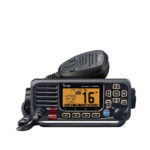
Compact communications with an external position fix

At the helm, a fixed radio earns its place when the channel is busy, the light is poor and a position needs to be sent without hesitation. The Icom IC-M330GE is made for that moment. It is a 25-watt very high frequency (VHF) radio with Class D Digital Selective Calling (DSC), a multi-constellation position receiver and a supplied external antenna. I see it as a particularly tidy answer for a wheelhouse or console where depth behind the panel is scarce but clear controls and dependable position data still matter.
Priced at £309 including VAT, the M330GE sits above two lower-priced alternatives and just below the Simrad RS20S. The case for spending the difference is not a decorative menu or a larger badge. It is the combination of an 88.2-millimetre body depth, a five-metre external Global Positioning System (GPS) antenna lead, an Ingress Protection X7 (IPX7) enclosure, Icom’s published receiver performance and a control layout that remains easy to read when my attention is divided between the screen, the channel and the water ahead.
A shallow radio for a crowded console
I start with the dimensions because they change the installation. The chassis measures 156.5 millimetres wide, 66.5 millimetres high and 88.2 millimetres deep, excluding projections, and weighs 730 grams. That depth is 11.8 millimetres less than the Standard Horizon, about 70.6 millimetres less than the Cobra and 73.2 millimetres less than the Simrad. In a compact helm with steering, switchgear and cable bends already competing for room, I regard that as a genuine engineering advantage rather than a line on a specification sheet.
The radio uses a directional keypad with context-sensitive soft keys, so the actions shown on the display match the task in hand. I like that arrangement because it shortens the route through common functions without filling the fascia with single-purpose buttons. The high-contrast dot-matrix screen is modest in size, yet the uncluttered front and clear labels make the information easy to take in. An internal two-watt speaker handles normal listening, while the external speaker output rises to 4.5 watts for a noisier enclosed helm. Networking uses National Marine Electronics Association (NMEA) 0183, including published compatibility with Icom’s MA-500TR Automatic Identification System (AIS) transponder.
Icom IC-M330GE vs Standard Horizon GX1400GPS/E vs Cobra MR F77 GPS E vs Simrad RS20S
| Fixed VHF radio | Current price inc VAT | Difference | Power and DSC | Size and weight | Positioning | Networking | Water rating | Controls and useful extras |
|---|---|---|---|---|---|---|---|---|
| Icom IC-M330GE | £309 | Reviewed model | 25W / 1W; Class D DSC | 156.5 × 66.5 × 88.2 mm; 0.73 kg | GPS, GLONASS and Satellite Based Augmentation System; external antenna with 5 m cable supplied | NMEA 0183 input/output; Icom MA-500TR AIS transponder compatible | IPX7; 1 m for 30 minutes | Directional keypad, soft keys, AquaQuake; receiver selectivity over 70 dB |
| Standard Horizon GX1400GPS/E | £165 | £144 less | 25W / 1W; Class D DSC | 156 × 61 × 100 mm; 0.8 kg | Integrated 66-channel GPS; external antenna not included | NMEA 0183 input/output | IPX8; 1.5 m for 30 minutes | 55 × 31 mm display, rotary selector; optional flush kit |
| Cobra MR F77 GPS E | £200 | £109 less | 25W / 1W; Class D DSC | 152.4 × 76.2 × 158.75 mm; 1.22 kg | Built-in GPS receiver and antenna | NMEA 0183 input/output | IPX8 / Japanese Industrial Standards 8 | 20-second Rewind-Say-Again recorder; public-address output |
| Simrad RS20S | £343 | £34 more | 25W / 1W; Class D DSC | 166.7 × 89.2 × 161.4 mm; 1.18 kg | Integrated 72-channel GPS | NMEA 2000 and NMEA 0183 | IPX7 | Inverted night display, rotary dial; 4W external audio |
I put the Icom first overall because its extra cost buys a much shallower installation, a supplied external position antenna, strong published receiver figures and AquaQuake water clearing in one compact set. Standard Horizon has the lowest price and a deeper immersion rating, but the Icom adds the external antenna package and trims another 11.8 millimetres from the body depth. Cobra provides useful message replay and public-address functions, yet its case is more than 70 millimetres deeper and nearly half a kilogram heavier. Simrad adds NMEA 2000 networking, but it costs £34 more, is substantially deeper and does not match the Icom’s supplied external antenna package. For the job I am judging—clear, position-aware VHF communication in a tight helm—the £309 Icom is the strongest complete purchase.
Position data that is not trapped behind the fascia
The M330GE receives GPS, the GLONASS satellite constellation and Satellite Based Augmentation System (SBAS) corrections. More importantly for an enclosed or heavily screened helm, the GE package includes an external antenna with five metres of cable. I can place that antenna where it has a sensible view of the sky rather than asking a receiver behind a dashboard to work through structure, wiring and glazing. That makes the package easier to plan honestly at installation time.
With a valid position, a properly registered DSC radio can include location information in a digital distress alert. The set also keeps a dedicated watch on Channel 70 for DSC traffic while the voice receiver is in use. I would verify the vessel’s Maritime Mobile Service Identity, position display and distress procedure during commissioning.
Networking without turning the radio into a project
The connection is NMEA 0183 input and output rather than the newer NMEA 2000 network. Icom also publishes compatibility with its MA-500TR Automatic Identification System (AIS) transponder. I find that a sensible fit for an existing boat whose instruments already use NMEA 0183, and the radio’s own receiver plus external antenna means its core position function is not dependent on another display being awake.
The networking choice needs to be understood before cables are cut. I would map the transmit and receive pairs, data speed and common ground against each manual. For a new all-NMEA 2000 helm, an interface or a different network plan may be involved, but the Icom remains self-contained for its central radio and position functions.
Receiver quality, water protection and daily use
Icom publishes more than 70 decibels of selectivity and intermodulation rejection for the receiver. In plain language, those figures describe its ability to separate the wanted transmission from strong nearby signals. I cannot turn a specification into a promise about every harbour, aerial or cable run, yet I value the margin when a compact radio is being installed around other electronics.
The Ingress Protection rating of X7 (IPX7) covers immersion to one metre for 30 minutes, and AquaQuake drives water from the speaker grille after spray. The radio operates from a nominal 13.8-volt direct-current supply and draws five amps while transmitting at 25 watts. I would give it a correctly fused circuit, sound cable terminations and a properly installed marine VHF aerial; the neat faceplate cannot compensate for voltage drop or a poor antenna system.
The supplied HM-235B hand microphone keeps channel selection and push-to-talk control familiar. Icom also publishes a minus 20 to plus 60 degrees Celsius operating range and states that the set is made in Japan and individually tested. I read those as purposeful details for regular service.
Erin’s verdict
I recommend the Icom IC-M330GE for an owner or skipper who wants a compact fixed radio with its own robust position source and clear controls. Its 88.2-millimetre depth solves a real fitting problem, while the supplied external antenna, multi-constellation receiver, dedicated DSC watch and AquaQuake function make the installation feel complete.
At £309, my decision rests on useful hardware rather than the cheapest entry price. The Icom is smaller behind the panel than all three alternatives, better equipped for an externally sighted position fix and backed by receiver figures that suit a busy radio environment. See the ICOM M330GE VHF radio at Flood Marine.
About this review
I used the live Flood Marine product page, Icom’s current official product page and specification, official manufacturer information for the three alternatives, and live UK retailer pages from Cactus Navigation and Rowlands Marine. I checked the advertised prices on 22 September 2026. This is my editorial assessment rather than an instrumented performance, durability or sea test. I am Erin McKee, the independent reviewer, and Flood Marine Services did not write this article.