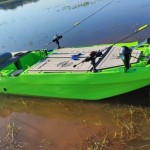
A fishing skiff that carries more ideas than weight

Most small boats give an angler somewhere to sit and then leave the rods, tackle and anchor to negotiate among themselves. The Milha takes the opposite approach. It starts with the fishing gear: eight moulded rod holders, three accessory tracks, locking lockers, dry hatches and a proper forward casting area. The people are then given the remaining 3.85 metres, which turns out to be plenty for one and useful for two.
The lime-green hull costs £2,995 including VAT before an outboard and transport equipment. It weighs 75 kilograms, carries a stated 200 kilograms and accepts up to 6 horsepower in petrol or suitable electric form. I like the honesty of its proportions. It is long and narrow enough to move easily, stable enough for the intended standing position and light enough that launching wheels, a roof rack or a very small trailer remain realistic.
Everything has somewhere to go
The bow anchor locker keeps wet rope away from tackle. Larger lockers use light-grey locking lids, while three dry hatches look after the items that object to a soaking. Rods can sit in the eight moulded holders instead of lying across the deck. The three fitted tracks accept optional mounts and holders without turning every new accessory into an appointment with a drill.
That organisation changes how the boat feels. A 1.08-metre beam is not wide, so loose equipment would quickly make the deck awkward. By moving gear into the hull and along the sides, the Milha keeps the central route and casting area clear. The boat has not discovered extra square metres; it has simply stopped wasting the ones it owns.
A 75-kilogram hull opens more launching places
The polyethylene construction is tough, colour-fast and easy to wash. At 75 kilograms, the hull is lighter than both the Rigiflex CAP 300 and Pioner 10 despite being 85 centimetres longer. Optional launching wheels can turn a short move to the water into a one-person job, while the flat, compact form suits simple transport arrangements.
Up to 6 horsepower is enough for the hull’s fishing and exploring brief. A small Yamaha petrol outboard gives range and familiar refuelling; a suitable electric drive makes quiet water and short sessions especially pleasant. The aluminium transom plate provides a proper mounting surface. This is not a kayak pretending to accept an engine. It is a small powered skiff that can still be paddled.
Milha Lite Skiff vs Rigiflex CAP 300 vs Pioner 10 Classic vs TAHE Sportyak 245
| Small polyethylene boat | Boat price including VAT | Length and weight | Crew and propulsion | Fishing layout | Storage and transport |
|---|---|---|---|---|---|
| Milha Lite Skiff | £2,995 | 3.85 × 1.08 m; 75 kg | 1–2 people; 200 kg stated; up to 6 hp petrol or electric | Stand-up casting foredeck; 8 moulded rod holders; three accessory tracks | Bow anchor locker, several locking lockers and three dry hatches; roof-rack or light trailer potential |
| Rigiflex CAP 300 | £2,050 | 3.00 m; about 90 kg | 3 people; up to 15 hp | Open utility interior; conventional bench arrangement | Shorter, heavier hull; general lockers rather than dedicated rod-and-track layout |
| Pioner 10 Classic | £2,250 | 3.00 m; about 120 kg | 3 people; up to 8 hp | Simple dinghy seating; broad general-purpose use | Robust rotomoulded hull; substantially heavier and less specialised for tackle |
| TAHE Sportyak 245 | £999 | 2.45 m; about 39 kg | 3 people at low loads; small outboard or oars | Compact tender floor; limited standing and tackle space | Easiest physical lift; far shorter hull with much less dedicated storage |
Advertised prices and published specifications checked 11 September 2026. The competitors are general-purpose small boats; the Milha is longer and built specifically around one- or two-person fishing and equipment storage.
The dearer boat carries the fishing features
Rigiflex and Pioner cost less and carry three people, with higher maximum-power figures. They are sound general-purpose dinghies, but both are shorter, heavier and arranged around benches rather than a standing casting deck, rod storage and accessory tracks. The Sportyak is wonderfully light and inexpensive, yet its 2.45-metre tender footprint cannot provide the same working length or tackle organisation.
The Milha price therefore buys a different amount of boat, not merely another polyethylene shell. It provides 3.85 metres at only 75 kilograms and uses that length for a specialised fishing layout. An angler can bring rods, an anchor, battery or fuel, safety kit and camping gear without stacking everything around the feet. That makes the boat faster to prepare and calmer to use.
Ciaran’s verdict
I would pick the Milha for a solo angler who values a clear deck and for two-person trips where every piece of gear needs a home. The casting platform, rod holders, tracks and lockers do more for the day than a large horsepower plate. Its low hull weight also means the boat can reach water that would be inconvenient with a conventional dinghy and road trailer.
The bright colour is useful for visibility and, admittedly, for finding the boat in a crowded yard. More importantly, the hull is tough, portable and properly thought through. The cheaper alternatives are ordinary small boats; the Milha is the complete little fishing workstation. View the Milha Boat in Lime Green.
I like the Milha’s refusal to complicate a simple fishing boat. I can see where the gear goes, I can move around it without stepping over moulded furniture, and the hull is light enough that a short outing still feels worth the bother.
About this review
I based this review on the product and manufacturer information listed in the sources, together with advertised UK prices checked on 11 September 2026. It is an editorial assessment, not an instrumented performance, durability or sea test. The words and opinions are Ciaran Hughes’s, and the article was not written by Flood Marine Services.