The twin-cylinder portable that feels grown up
Eight horsepower is where a portable outboard starts doing several jobs properly. It can push a substantial tender, serve as an auxiliary on a sailing boat or spend the summer on a compact fishing craft. That broader brief asks more of the engine than a good power figure. Smooth low-speed running, manageable weight, clean storage and dependable starting all begin to matter together.
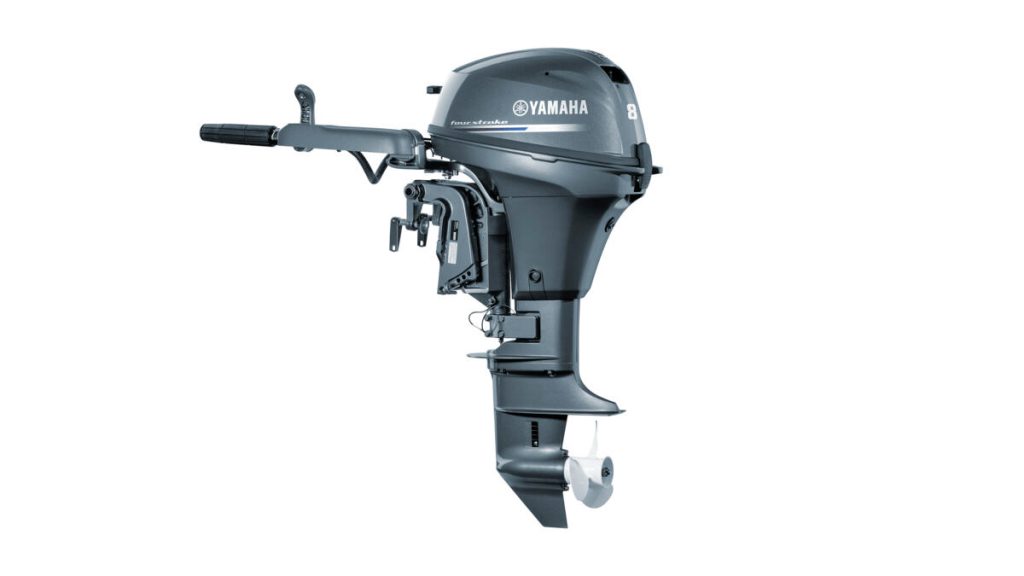
The Yamaha F8 starts at £2,270 including VAT in the manual-start tiller form, including the propeller, a 12-litre external tank and fuel hose. The family extends to different shaft lengths and electric-start or remote-control arrangements, while the FT8 high-thrust relation is there for heavier displacement work. I like that breadth. It lets the engine family follow the boat rather than forcing every boat into one specification.
A twin cylinder earns its keep at this size
The 212 cubic-centimetre twin-cylinder block gives the F8 a calmer beat than a single-cylinder portable. That is easy to dismiss on a short demonstration, yet it becomes important during an hour of trolling or a long push back to a mooring. Less vibration reaches the tiller and transom, and throttle changes feel measured rather than abrupt. The published family weight of 40 to 43 kilograms is substantial enough to plan around, but still within the normal range for two-cylinder eights.
The fold-back tiller and dedicated rest position help when the engine is carried or laid down correctly. A shallow-water drive setting protects the leg when edging towards a beach, and the fresh-water flushing connection makes the salt-rinse routine simple. The six-amp alternator on suitable versions is useful for maintaining a starting or service battery. Each feature deals with a routine annoyance that can otherwise make an auxiliary tiresome to own.
Commercial use tells a useful story
F8 and FT8 engines appear on tenders, sailing-school craft, harbour launches and displacement auxiliaries as well as leisure boats. That mix matters. An engine used for repeated short journeys sees plenty of cold starts, gear changes and low-speed running. Yamaha’s record in that work has helped the small four-stroke range earn a dependable name without relying on a heroic claim.
Regular maintenance remains part of the bargain, but the servicing route and parts knowledge are well established. A clean Yamaha portable also has broad recognition in the second-hand market. I would never promise a future resale figure; I would say that familiar models with recorded care are easier to value and easier to sell. Over several seasons, that retained demand narrows the meaning of the initial price difference.
Yamaha F8 vs Tohatsu MFS8C vs Honda BF8 vs Suzuki DF8A
| 8 hp outboard | Price including VAT | Engine and weight | Included starting package | Control and storage | Long-term case |
|---|---|---|---|---|---|
| Yamaha F8 | £2,270 | 212 cc twin; 40–43 kg family range | Propeller, 12-litre tank and hose included | Fold-back tiller; shallow-water drive; fresh-water flushing; 6 A alternator | F8 and high-thrust FT8 choice; established auxiliary and commercial use; recognised resale market |
| Tohatsu MFS8C S | £1,856 | About 209 cc twin; around 38 kg | Package contents depend on listing | Manual tiller; compact portable layout | Competitive weight and price; smaller UK used-market presence |
| Honda BF8 SHU | £2,753 | 222 cc twin; around 42 kg | Fuel tank and standard rigging by package | Manual tiller; folding handle; charging availability by version | Well-established four-stroke range; higher advertised entry price here |
| Suzuki DF8AS | £1,995 | 208 cc twin; around 39.5 kg | External tank and propeller terms vary | Manual tiller; shallow-water position; offset crankshaft design | Light and compact; dealer-package detail needs comparing alongside price |
Prices and published specifications checked 11 September 2026. The Yamaha figure is for the listed manual-start tiller package; other variants and retailer inclusions alter like-for-like totals.
The useful differences are not hidden in horsepower
Tohatsu posts the lowest advertised figure and a slightly lower published weight. Suzuki is light too, while Honda brings the largest displacement and a long four-stroke history of its own. The Yamaha answer is the way its equipment, family choice and ownership record arrive together. The listed propeller, tank and hose give the base package a clear starting point; the standard F8 and high-thrust FT8 routes then cover two genuinely different kinds of boat.
There is also a balance to the controls. The F8 is portable without being stripped of the features that make regular use pleasant. Shallow-water drive, flushing, a folding tiller and useful charging support all earn their space. A lower price can be attractive, but it should be compared with the same fuel equipment, propeller, shaft and starting arrangement. Once that is done, Yamaha’s premium buys a notably complete engine rather than a different badge on the same list.
Neil’s conclusion
The Yamaha F8 is the one I would choose for an owner who expects the engine to move between tender work, fishing and auxiliary duty over a long period. The twin-cylinder refinement is worth having, the storage details are properly thought through and the wider F8/FT8 family means there is a sensible route for both planing and displacement hulls.
Its reliability reputation comes from repeated leisure and commercial use, and its resale strength comes from the same familiarity. Those qualities are not printed as horsepower, but they continue working after the first season. Add the included propeller, tank and hose, and the F8 becomes the most rounded purchase in this group. View the Yamaha F8 product page.
About this review
I based this review on the product and manufacturer information listed in the sources, together with advertised UK prices checked on 11 September 2026. It is an editorial assessment, not an instrumented performance, durability or sea test. The words and opinions are Neil Duddy’s, and the article was not written by Flood Marine Services.