Serious Portable Electric Thrust
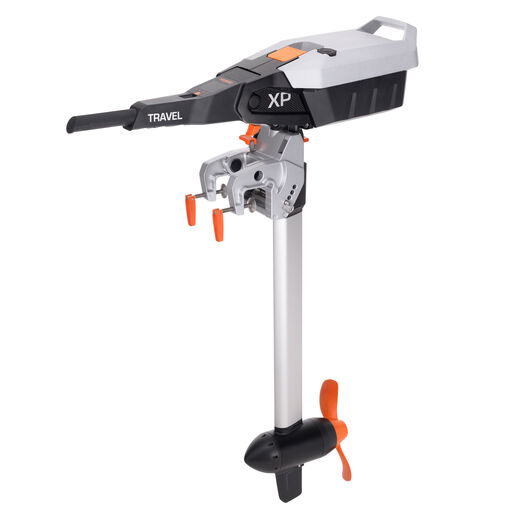
An owner buying portable electric power for a heavily loaded tender has one practical decision to make before anything else: is the motor merely quiet, or does it have enough reserve to keep the boat controllable when wind, tide and extra kit arrive together? The Torqeedo Travel XP S package answers with 1,600 watts (W) of electrical input, 1,400 W at the propeller shaft and a published five-horsepower (hp) equivalent. At £3,100 with the Travel Battery XP, it is a serious drive rather than an auxiliary chosen only for calm water.
The reviewed bundle is the short-shaft, tiller-controlled Travel XP S with the current 1,512 watt-hour (Wh) removable battery. Torqeedo rates the Travel XP family for tenders, dinghies and daysailers up to two tonnes. I would still match any outboard to the particular hull, loading and local conditions, but those figures establish why this package sits above the familiar one-kilowatt portable class.
Why the XP package matters
The useful gain is not simply a larger number on the cowl. More available thrust gives me finer control over a loaded tender at low speed and more authority when the weather changes during the return trip. The direct-drive motor has stepless forward and reverse, while a lever selects full 360-degree steering, a restricted plus-or-minus 60-degree arc or a fixed position. Four manual trim settings, up to 90 degrees of tilt and shallow-water positions make the unit adaptable at a beach, pontoon or drying harbour.
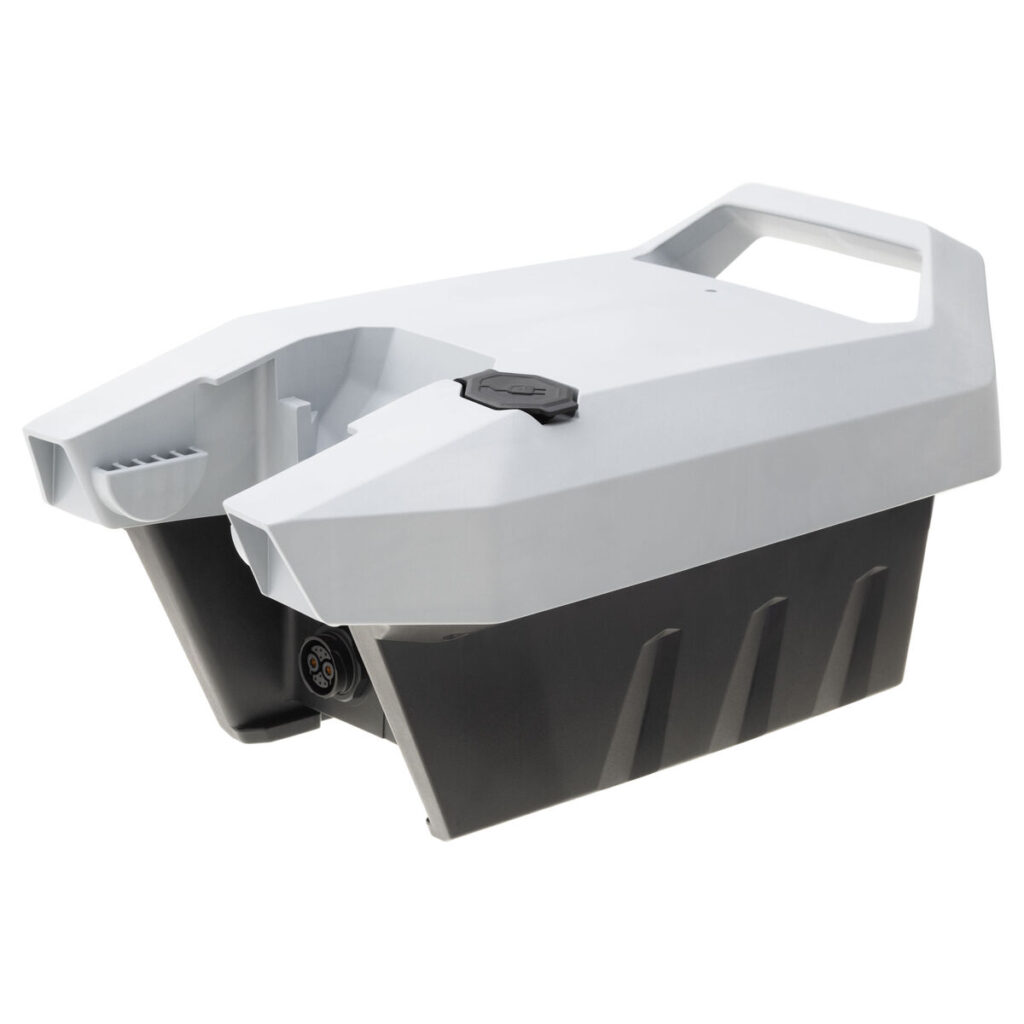
Portability remains credible because the system separates. The short-shaft motor weighs 12.6 kg and the battery 9.6 kg, giving a 22.2 kg total without asking one person to lift the entire assembly at once. The battery clicks into place without an external power lead. I like that division: the motor can be clamped on first, the battery carried aboard second, and neither lift is disguised as lightweight by quoting only half the system.
The 62.5 cm shaft is the reviewed S configuration, so transom height must be checked before purchase. The wider Travel XP family also includes long-shaft and remote-control versions. This bundle is the folding-tiller model, supplied with the 180 W mains charger, propeller, magnetic emergency-stop chip, shaft anode, fin and instructions. That is the usable package I am comparing, not a bare motor beside competitors sold with batteries and chargers.
Information, charging and range
A backlit colour display reports speed, consumption, battery charge and remaining range in time or distance. Integrated Global Positioning System (GPS), Wi-Fi and Bluetooth connect to the TorqView app for maps, trip records, usage statistics, maintenance information and software updates. I see this as practical energy management. A remaining-range figure beside live consumption lets the operator reduce power early and watch the estimate respond, which is far more useful than discovering reserve only through a falling battery bar.
The included 180 W charger is a sensible standard unit. Optional leads allow charging from a 12- or 24-volt direct-current (DC) supply or from solar panels up to 200 W peak. Torqeedo’s published trial with a 3.8 m inflatable reported 10 km/h and 7.8 km at full power, 7.8 km/h and 12.2 km at half power, and 6.5 km/h and 20.4 km at the slow setting. Those are controlled examples at 22°C, not promises for every boat; hull, load, tide, wind and temperature will alter the result. Their real value is showing how strongly range improves when I ease back from maximum demand.
Torqeedo Travel XP S vs ePropulsion Spirit 1.0 Plus vs TEMO·1000 vs Mercury Avator 7.5e
| Electric outboard | Current UK price | Difference vs Torqeedo | Published drive output | Battery | Carry split | Shaft and control | Display and connection | Charger and package |
|---|---|---|---|---|---|---|---|---|
| Torqeedo Travel XP S + Travel Battery XP | £3,100 | — | 1,600 W input; 1,400 W shaft; 5 hp equivalent | 1,512 Wh removable lithium battery | 12.6 kg motor + 9.6 kg battery = 22.2 kg | 62.5 cm short shaft; folding tiller | Backlit colour display; GPS, Wi-Fi and Bluetooth; TorqView app standard | 180 W mains charger, battery, propeller and magnetic stop chip included |
| ePropulsion Spirit 1.0 Plus S | £1,875 | £1,225 less | 1,000 W; 3 hp equivalent | 1,276 Wh removable floating battery | 10.6 kg motor + 8.7 kg battery = 19.3 kg | Extra-short, short or long; tiller | Digital display; no integrated GPS or app connection stated | Standard charger, battery, propeller and kill switch included |
| TEMO·1000 | £2,299 | £801 less | 1,100 W; 3 hp equivalent | 949 Wh removable cable-free cassette | 16 kg published total; battery about 7 kg | 8.5–37.8 cm sliding height; retractable tiller | On-board computer; no app connection stated | 220 V charger, battery, bracket and magnetic key included |
| Mercury Avator 7.5e | £3,200 | £100 more | 890 W input; 750 W shaft; 3.5 hp comparable | 1,030 Wh quick-connect battery | 19.5 kg excluding battery + 7.7 kg battery = 27.2 kg | 381, 508 or 635 mm; tiller or remote | Colour display and GPS; wireless app link needs optional module | 110 W charger and battery included in cited package |
The ePropulsion is £1,225 lower and carries in a lighter 19.3 kg split, but its one-kilowatt output and 1,276 Wh battery leave a clear performance gap, and integrated GPS or an app connection is not stated for the Plus model. TEMO’s 16 kg published total, adjustable sliding mount and £2,299 price are attractive engineering, yet its 1,100 W motor and 949 Wh battery provide less power and stored energy. Mercury offers three shaft lengths, polished controls and integrated GPS, but the cited package is £100 dearer, has 750 W rated shaft output, a 1,030 Wh battery and needs an optional module for wireless app functions. I put the Torqeedo first because it combines the highest output, largest battery, standard connected information and a faster included charger in one portable package.
Ownership and working use
Electric propulsion removes fuel handling, exhaust at the tender and routine oil changes, but it still rewards disciplined ownership. I would rinse salt away, inspect the propeller and anode, protect the connectors, charge with the approved equipment and store the battery within Torqeedo’s guidance. High-hour operators should also plan charging time and a repeatable lifting routine. The quieter drive and instant response are valuable every day; the display’s trip and maintenance information helps turn those benefits into an organised operating pattern.
The higher purchase price earns its place where a tender carries people and gear regularly, where a daysailer needs meaningful reserve, or where an operator values accurate range information as much as silence. The XP is not relying on a badge to explain the money. Its published output is 60% above the Spirit’s one-kilowatt figure, the 1,512 Wh battery is the largest in this comparison, and the connected display is standard rather than an add-on.
My verdict
I would choose the Torqeedo Travel XP S and Travel Battery XP package at £3,100 for a short-shaft tender or daysailer that needs genuinely portable electric propulsion with useful reserve. The 12.6 kg motor and 9.6 kg battery remain manageable as separate lifts, while 1,600 W input, the 1,512 Wh battery and clear range information make the system convincing beyond flat-water pottering. See the exact Travel XP S and Travel Battery XP package at Flood Marine.
About this review
Specifications and prices were checked against the live Flood Marine listing, the current Torqeedo product page and operating manual, official ePropulsion, TEMO and Mercury material, and the named UK competitor listings on 3 October 2026. This is an editorial assessment rather than an instrumented performance, durability or sea test. Neil Duddy is the independent reviewer; the article was not written by Flood Marine Services.