Fifteen amps with the charging history in hand
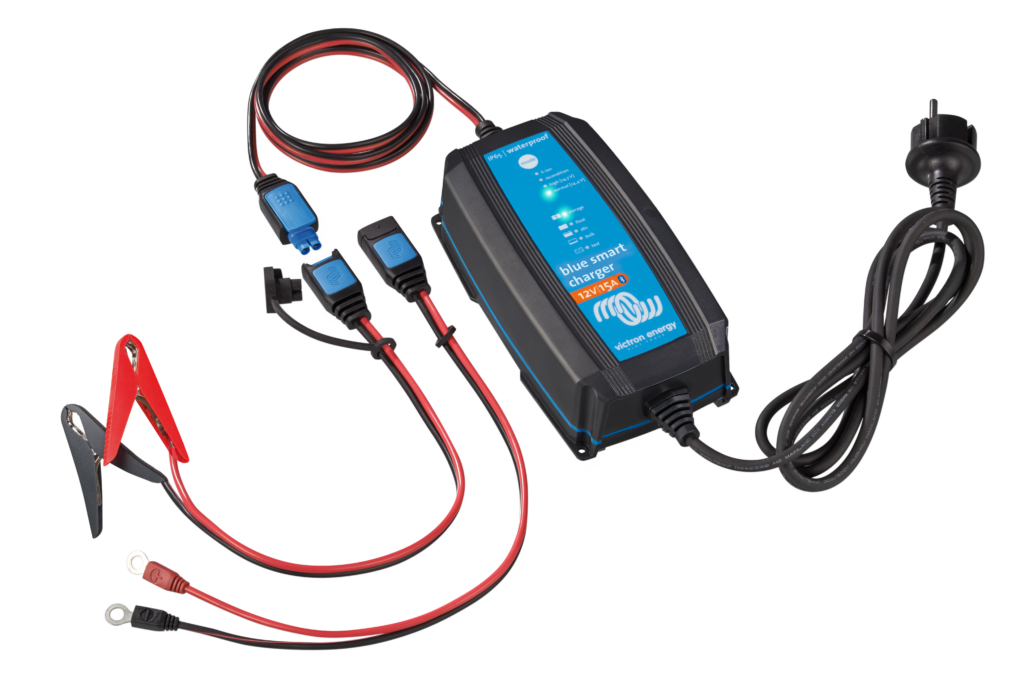
At the helm after a boat has sat on shore power, I want clear battery information: charging stage, present voltage and a profile that matches the fitted battery. I value being able to check that detail without opening a locker. The Victron Blue Smart 12/15(1) combines a 15-amp charger with built-in phone monitoring, and Flood Marine lists the United Kingdom retail version at £144 including VAT.
The name needs translating before the feature list becomes useful. This is a 12-volt charger delivering up to 15 amps through one output from a 230-volt mains supply. Its Ingress Protection (IP) rating of 65 covers the enclosure against dust and water exposure specified by the manufacturer, while Victron also states chemical resistance. The unit measures 190 by 105 by 60 millimetres and weighs 0.9 kilograms. Published efficiency sits in the mid-nineties, with Victron’s current official page quoting 95%.
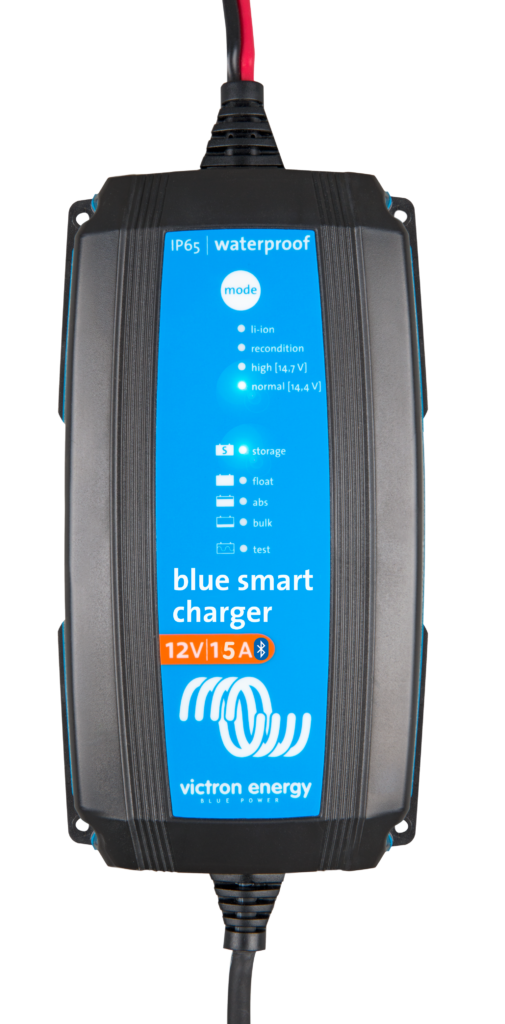
Battery support is unusually broad at this price. The selectable profiles cover conventional flooded lead-acid, absorbed glass mat (AGM), gel and lithium batteries, including a dedicated lithium-ion setting, while a custom profile allows finer adjustment. VictronConnect communicates by Bluetooth, and power-supply mode provides a steady direct current (DC) output. Those definitions matter before the table because the alternatives divide sharply between local displays, wired remotes and app-based control.
Victron Blue Smart IP65 Charger 12/15(1) vs Mastervolt EasyCharge 10A vs ProMariner ProNauticP 1215P vs Sterling Pro Charge Ultra PCU1210
| Battery charger | Current price | Difference | Charge output | Charging control | Battery support | Environmental protection | Monitoring and controls | Size and weight | Extra modes |
|---|---|---|---|---|---|---|---|---|---|
| Victron Blue Smart IP65 12/15(1) | £144 | Reviewed model | 12 V / 15 A; one output | 7-stage algorithm; 8 presets plus custom profile | Flooded, AGM, gel and other lead-acid; lithium | IP65 water, dust and chemical protection | Built-in Bluetooth; VictronConnect live status, history and settings | 190 x 105 x 60 mm; 0.9 kg | Storage, reconditioning, low-power and power-supply modes |
| Mastervolt EasyCharge 10A | £270 | £126 more | 12 V / 10 A or 24 V / 5 A; one or two banks | Automatic 3-step+; Sense-Send bank priority | Flooded, AGM and gel | IP68 sealed epoxy-filled enclosure | No MasterBus or built-in app control | 178 x 127 x 51 mm; 2.8 kg | Series or parallel output configuration |
| ProMariner ProNauticP 1215P | £617 | £473 more | 12 V / 15 A; three banks | Up to 12 selectable 4-stage profiles | Flooded, sealed, AGM, gel, lithium and custom profiles | Ignition protected; vented enclosure | Dual local displays; optional wired digital remote | 260 x 216 x 89 mm; 2.3 kg | Distributed-On-Demand; power-supply and conservation modes |
| Sterling Pro Charge Ultra PCU1210 | £289 | £145 more | 12 V / 10 A; two outputs | 11 presets plus user-configurable profile | Lead-acid, AGM, gel, calcium and lithium iron phosphate | IP22 when correctly mounted vertically | Local voltage/current displays; optional wired remote | 260 x 215 x 90 mm; 2.0 kg | Power reduction; desulphation; global mains input |
I regard the Victron as the strongest overall purchase for a single 12-volt battery output. The Mastervolt brings full IP68 sealing and two-bank flexibility, but it supplies 10 amps, omits app monitoring and costs £126 more. ProMariner matches the 15-amp rate and adds three banks, yet the £617 price is £473 higher and the enclosure is much larger. Sterling supplies two outputs and detailed local controls for £289, but its 10-amp output, optional rather than integrated remote and IP22 installation rating leave the £144 Victron ahead on charge rate, information access, size and value.
Clear information without opening the locker
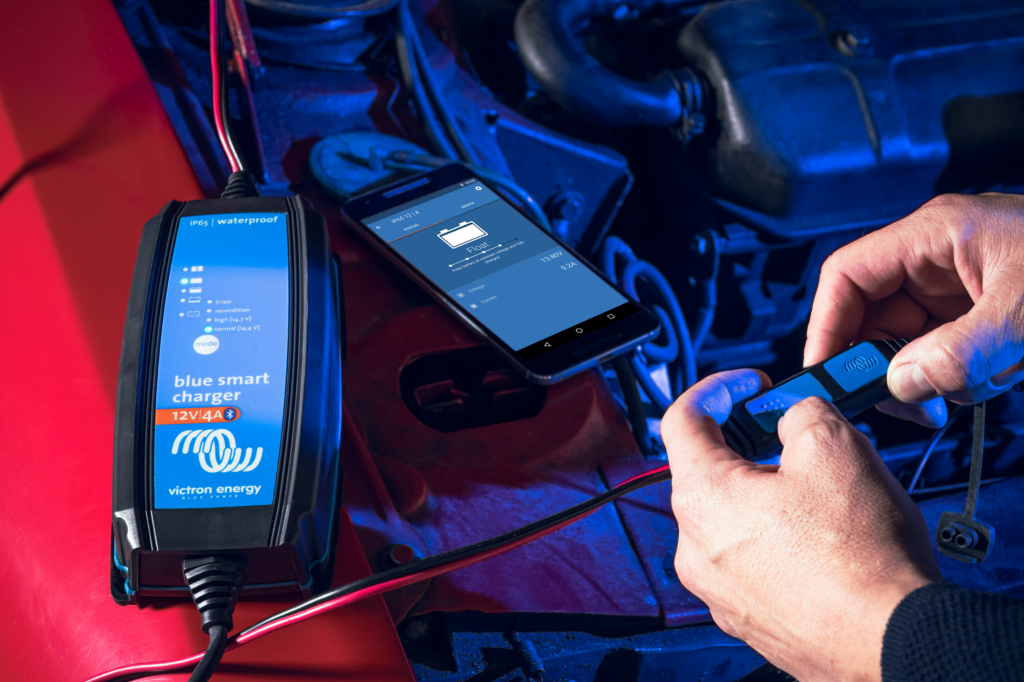
VictronConnect is the feature I would notice on every visit to the boat. The app shows live charging status, voltage and current, records history and allows the profile to be changed. I can check whether the charger is in bulk, absorption, float or storage from a comfortable position instead of reading tiny labels beside a battery box. That is not decoration. Clear history can reveal a battery that repeatedly starts from a low state of charge or a shore-power routine that is not doing what the owner assumed.
I also like the separation between presets and a custom profile. Where a battery maker publishes specific voltage limits, the configurable route can follow them. I would record the selected profile beside the battery documentation. A phone makes the controls easier to reach; it does not turn chemistry settings into guesswork.
What the seven-stage algorithm is doing
The charger first assesses the battery, then moves through controlled stages rather than applying one fixed voltage indefinitely. Victron describes a fast charge towards 80%, followed by a slower final portion matched to the selected chemistry. Once full, storage mode reduces the long-term voltage instead of holding the battery at an unnecessarily high level. For a boat that spends weeks between outings, I consider that a more thoughtful ownership feature than a simple trickle charge.
Reconditioning mode is intended for suitable lead-acid batteries affected by partial-charge use and sulphation. It is a deliberate mode, not something I would apply casually to every bank. Low-power mode is helpful with smaller batteries, while the dedicated lithium setting works within the tighter voltage behaviour of that chemistry. Victron also publishes automatic temperature compensation across an ambient range from minus 20 to plus 50 degrees Celsius, measuring conditions at low current before adjusting the algorithm.
Power-supply mode broadens the job
Power-supply mode lets the Blue Smart provide constant DC voltage with or without a battery connected. That is useful during maintenance, commissioning or work on 12-volt equipment when a stable source is required. I would set the voltage to suit the equipment and isolate circuits in the normal way. It is a practical extra because it gives the charger a second job without another box taking space in the locker.
The one-output layout is equally clear. This reviewed model is aimed at one battery or one connected bank, and its full 15 amps serve that output. A multi-bank charger belongs to a different installation plan, including cable routes, isolation and battery priorities. In the defined single-output job, I would rather have Victron’s higher current, integrated monitoring and compact enclosure than pay at least £126 more for additional outputs that are outside the brief.
Protection, mounting and daily ownership
The IP65 enclosure is well suited to the damp, dusty reality of marine storage, and SafetyShield+ adds safeguards for overtemperature, short circuit and reverse polarity. I would still mount the charger where air can circulate, leads are protected from strain and water cannot pool around the case or connectors. IP65 is meaningful protection, not permission to leave an electrical connection sitting in bilge water.
The United Kingdom plug, 0.9-kilogram weight and modest footprint make this version easy to position near an appropriate mains outlet. Cable length, fuse arrangements and battery-terminal connection still need to follow the manual and the boat’s electrical design. I would also label the charger with the bank chemistry and keep VictronConnect updated, because the best interface is the one that remains understandable to the next person aboard.
At the end of a season, storage mode and the history screen work well together. I can confirm that the bank reaches its maintenance stage and spot an unusual pattern before spring. That quiet visibility is where the Blue Smart earns its name for me.
Erin’s verdict
I recommend the Victron Blue Smart 12/15(1) for a 12-volt single-bank installation where the owner wants useful charging current, broad battery support and genuinely clear monitoring. The 15-amp output is matched by ProMariner here, but none of the three alternatives combines this price, compact size, IP65 enclosure and built-in app access.
At £144, my choice is confident. The Victron turns charging status, history and profile control into information I can use, while its seven-stage care, storage, reconditioning and power-supply modes cover both the season and the lay-up. See the Victron Blue Smart IP65 12/15(1) charger at Flood Marine.
About this review
I based this editorial assessment on the live Flood Marine product and competitor pages, Victron’s current official product page and data, Mastervolt’s EasyCharge specification, ProMariner’s official catalogue and Sterling Power’s current PCU1210 page. I checked those advertised prices on 21 September 2026. It is an editorial assessment rather than an instrumented performance or durability test, and it is not a sea test. I wrote it independently as Erin McKee; Flood Marine Services did not write it.
More detail